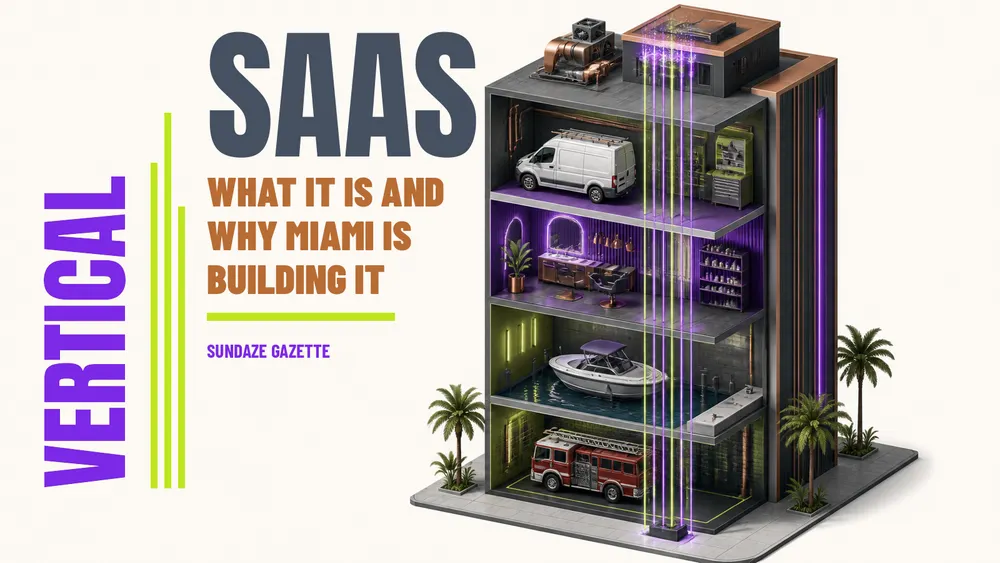
Picture a plumber in Hialeah, a salon owner in Coral Gables and a marina manager in Fort Lauderdale all run a business, but they do not run the same business. The plumber needs dispatch, quotes and job invoices. The salon owner needs bookings, deposits and client notes. The marina manager needs slip reservations and boater payments. For years most of them bent general tools to fit. A growing class of software companies now builds one product for one industry, and that model has a name: vertical SaaS.
Miami is becoming one of its meeting points. On Nov. 4 and 5, 2026, the second annual Vertical Software Summit at the Rubell Museum in Miami brings founders, operators and investors in the category to Allapattah, and two of the best known operators in the space now run their companies from Miami.
What is vertical SaaS?
Vertical SaaS is subscription software built for one specific industry, such as the trades, salons, marinas or fire departments, rather than for every kind of business. It usually bundles the core daily jobs of that industry, like scheduling, quoting, invoicing and payments, into one system designed around how that trade actually works.
Vertical Versus Horizontal, in Plain Terms
SaaS stands for software as a service: software a business rents by subscription and uses through a browser or app, rather than buying once and installing. Most familiar SaaS products are horizontal. A spreadsheet, an email platform or a general accounting package serves any business in any industry, and each owner adapts it to their own work.
Vertical software flips that. It starts with one industry and builds around that industry's specific steps, vocabulary and rules. Simpro, for example, describes itself on its own site as field service software for trade businesses, including electrical, plumbing and HVAC contractors, connecting office and field teams through quoting, scheduling, job management and invoicing. The summit page describes Dockwa, whose chief executive is a listed speaker, as an operating system for the marine economy that brings software, payments and a boater marketplace together for marinas. First Due, another speaker company, builds software for fire, EMS and law enforcement agencies, according to the summit page.
The Vertical SaaS Group, which organizes the Miami summit, frames the difference as a separate discipline. Its founder, Luke Sophinos, writes on the group's about page that operator support had been tied to traditional SaaS and was lacking for vertical founders, who face "different GTM motions, different investor requirements, different Customer Success approaches." GTM is shorthand for go to market, meaning how a company finds and sells to customers.
Why the Model Works for Software Companies
The appeal for builders is depth. A horizontal product competes with every other general tool on the market. A vertical product competes within one industry, and if it becomes the system a trade runs on, it can add more services over time.
The clearest sign of that on the Miami agenda is money movement. The summit program includes a session titled "Embedded Finance: How Vertical Software Companies Are Unlocking the Next Revenue Layer" and another on "Embedded Accounting: The Next Revenue Layer for Vertical Software Founders." Payabli, a summit sponsor, is described on the conference page as an operating system that helps vertical SaaS platforms "embed and monetize financial services as a core part of their business model." In plain terms, once a salon books and bills through one platform, that platform can also process the card payments, offer a cash advance or keep the books.
The other sign is consolidation. Valsoft's founder, Sam Youssef, is scheduled to speak on "M&A Lessons From 100+ Vertical Software Acquisitions," and the conference page describes Valsoft as one of the most active vertical software buyers in the world. Buyers like that look for small, specialized software companies with loyal customers in a single niche.
Why the Model Matters for Business Owners
For an owner, vertical software can replace a stack of separate tools with one system that already speaks the industry's language. A field service platform knows what a service agreement or a change order is. A salon platform knows what a no show deposit is. That can mean less setup and fewer workarounds.
It also creates tradeoffs worth weighing before signing up:
- Payments are often built in, which is convenient, but it ties processing fees to the software choice. Owners should compare those rates the same way they compare a stand alone processor.
- Moving off a platform that holds bookings, customer history and invoices can be harder than leaving a general tool. Ask how data can be exported before committing.
- Bundled lending or cash advances may be offered inside the dashboard. Read the terms as closely as a bank offer.
- Smaller niche vendors can be acquired. Ask about the product roadmap and what changes if ownership changes.
None of this is a reason to avoid vertical software. It is a reason to buy it with the same care as any other long term vendor.
Why Miami Is Building It
Three threads tie the category to Miami right now.
The first is headquarters. Kaseya, which makes IT management and security software for managed service providers and IT departments, says on its company page that it is headquartered in Miami, and its contact page lists its HQ at 333 SE 2nd Avenue in downtown Miami. The company says more than 500,000 IT professionals use its products. Simpro, the trades software company, says on its about page that Miami welcomed its new international headquarters in 2025, and it lists Fred Voccola, founder and former chief executive of Kaseya, as its chairman and chief executive.
The second is the meeting place. The Vertical Software Summit chose Miami for its first edition in October 2025 and returned for 2026. The conference page expects about 400 attendees this year, says the organizers turned more than 100 people away last year, and calls it "The Vertical AI event of the year." Voccola is scheduled for a Nov. 4 session titled "Building Two Billion Dollar+ Vertical Businesses Across Multiple Eras."
The third is capital. The summit page lists investors expected to attend, including Thoma Bravo, Goldman Sachs, Google Ventures, Insight and PSG, along with two firms with Florida ties, 305 Ventures and Florida Funders. Florida Funders, based in Tampa, says on its site that it has deployed more than $300 million across more than 100 portfolio companies and invests in early stage business to business technology companies from pre seed through Series B. The summit page also says several founders told organizers they met the investor who led their next round at last year's event.
No state agency or other primary source reviewed publishes a count of vertical software companies based in Miami or Florida.
Vertical AI, the Next Chapter
The summit's own tagline pairs vertical software with vertical AI, and the agenda reflects it. Cecilia Ziniti of GC AI, which the conference page describes as vertical AI for in house legal teams, is scheduled to speak on "From 0 to Hyper-Growth: The Vertical AI Playbook." Andreas Huber of First Due is set to discuss "Rewiring a $1B Vertical SaaS Company To Be AI First / AI Native." Simpro describes itself as an "AI-first" operating platform for the trades.
For owners, the practical meaning is that AI features are increasingly arriving inside industry software rather than as separate tools. A scheduling assistant inside a field service app or an automated rebooking prompt inside a salon platform is vertical AI at work. Owners can ask their current vendors what AI features are on the roadmap, what data those features use and whether they cost extra.
How to Use This if You Run or Build a Business in Florida
If you run a business, take stock of the tools you already pay for. If three or four separate products handle scheduling, invoicing, payments and customer records, ask whether a platform built for your industry would replace them and what it would cost in subscription and processing fees.
If you build software or are thinking about it, the Miami summit is the clearest local entry point this fall. The conference page lists tickets through a Luma registration page where each tier requires approval. Investors and service providers who sell to software companies, such as payments, accounting or IT firms, will also find their buyers there.
If you are job hunting, companies headquartered here, including Kaseya and Simpro, post roles on their own career pages, and vertical software firms tend to hire people with experience in the industry they serve, not only engineers.
Get South Florida tech, AI and business news in your inbox: sign up for the free Sundaze Gazette newsletter.
Sources
- Vertical SaaS Group, Vertical Software Summit 2026 conference page
- Vertical SaaS Group, About Luke Sophinos
- Simpro, About Simpro
- Kaseya, About Kaseya
- Kaseya, Contact and locations
- Florida Funders, home page
Related
- Vertical Software Summit Miami, Nov. 4 to 5
- AI Events for South Florida Owners
- Work and AI Events in South Florida
Key Facts for Owners and Search
What is vertical SaaS?
Vertical SaaS is subscription software built for one industry, such as HVAC and plumbing contractors, salons, marinas or fire departments, instead of for every business. It typically combines that industry's daily work, including scheduling, quoting, invoicing and payments, in one system designed around how the trade operates, which is the opposite of general horizontal tools like spreadsheets.
What is the difference between vertical and horizontal SaaS?
Horizontal SaaS serves any business in any industry, like email, spreadsheets or general accounting tools that each owner adapts. Vertical SaaS starts with one industry and builds around its specific steps and rules, then often adds payments, accounting or lending inside the product. Vertical tools go deeper in one niche, while horizontal tools reach across many.
Why is Miami a hub for vertical software?
Kaseya, which makes IT management software for managed service providers, lists its headquarters in downtown Miami, and trades software company Simpro says it opened its international headquarters in Miami in 2025. The Vertical Software Summit also returns to Miami's Rubell Museum on Nov. 4 and 5, 2026, with about 400 founders, operators and investors expected.
What are examples of vertical SaaS companies?
Examples named on the Vertical Software Summit program include Simpro for electrical, plumbing and HVAC trades, GlossGenius for beauty and wellness professionals, Cents for laundromats, Dockwa for marinas, First Due for fire and EMS agencies and GC AI for in house legal teams. Valsoft, also on the program, buys and runs vertical software companies across many industries.
Should a small business switch to vertical software?
It can help when several separate tools handle scheduling, invoicing, payments and customer records. Before switching, compare subscription and card processing fees, ask how data can be exported if you leave, read any built in lending terms closely and ask what changes if the vendor is acquired. Treat the choice like any long term vendor contract.