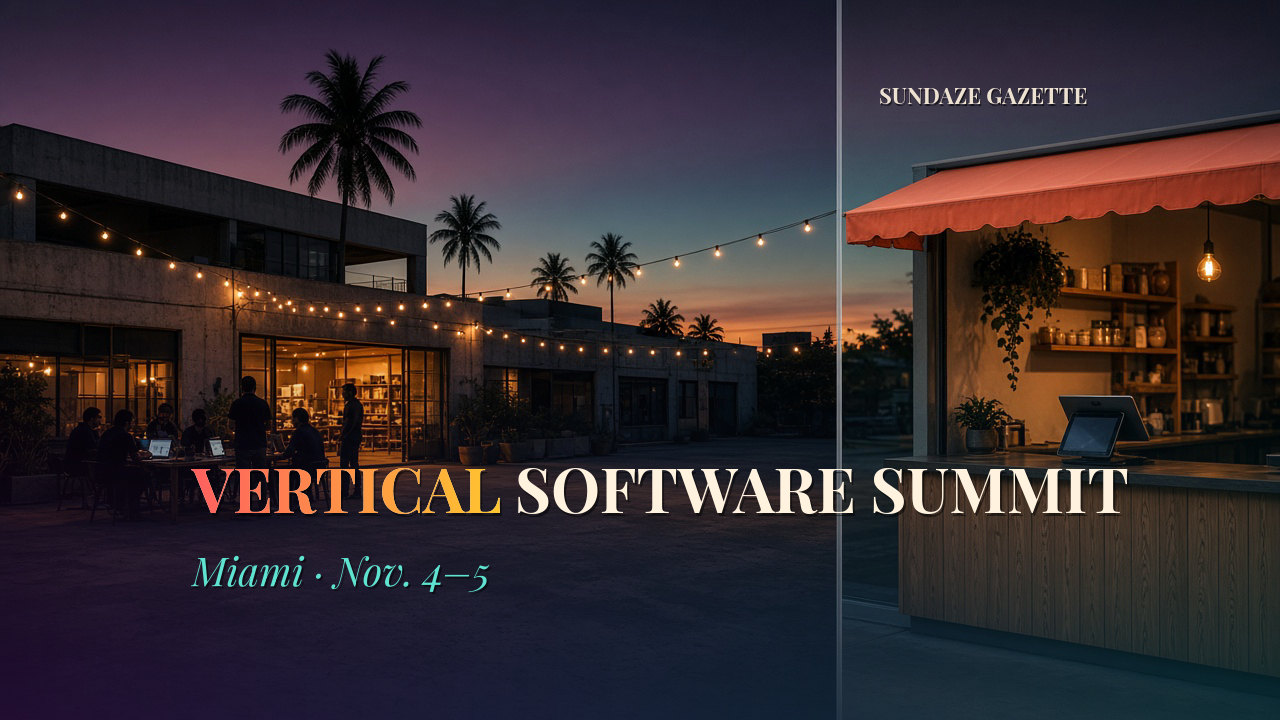
At 10:45 a.m. on Wednesday, Nov. 4, check-in opens at the Rubell Museum in Miami’s Allapattah neighborhood, and the first item on the tentative agenda is not a keynote but light bites and networking. Forty-five minutes later, the second annual Vertical Software Summit is scheduled to open with “The State of Vertical Software in 2026,” from Luke Sophinos of the Vertical SaaS Group and Raj Bhaskar, co-founder and CEO of Tight.com. By 4:45 p.m., the schedule has Fred Voccola, chairman and CEO of Simpro and founder and former CEO of Kaseya, on stage for “Building Two Billion Dollar+ Vertical Businesses Across Multiple Eras.” It is a program built by software founders for software founders, and the conference page says so plainly.
That plainness is useful, because South Florida has a crowded AI calendar this fall and not every event is meant for the same person. A restaurant owner, a salon owner and a landscaping contractor could all read “Vertical AI event of the year” and reasonably assume it is about them. Some of the companies on stage do build software for exactly those owners, but the summit itself is aimed at the people who build, fund and sell that software. This is a map of who belongs in that room and who will get more from a different one.
A Warehouse Full of Software People
The Vertical SaaS Group describes itself as a community for vertical software and AI founders, operators and investors, with case studies, a newsletter, a podcast, workshops and an annual summit. Sophinos writes on the group’s about page that he founded Portico, formerly CourseKey, a software company for trade schools that he sold to Providence Strategic Growth in 2024, and that he is now an operating partner at Atomic. The conference page bills the summit as “the only Vertical AI and Vertical Software Summit by founders/operators/investors for founders/operators/investors.”
The first edition ran Oct. 16–17, 2025, in Miami, and Sophinos wrote afterward on LinkedIn that it drew “200+ vSaaS trailblazers.” The 2026 page expects about 400 attendees, roughly double the room. It also says organizers “had to turn 100+ away” last year from people who waited until the last minute, and it warns that this year’s event “will sell out early.”
The venue suits a crowd that likes to talk about category creation. The Rubell Museum opened in December 2019 in six interconnected former industrial warehouses, transformed by Selldorf Architects, and its fact sheet lists 8,700 square feet of flexible space for performances and special events. The conference page does not say which parts of the museum the summit will use.
What “Vertical Software” Means, and Why Owners Should Care
Vertical software is software built for one industry rather than for everybody. A general calendar or spreadsheet serves any business, while a vertical product is designed around the specific work of a laundromat, a hair salon or a marina. The speaker list reads like a tour of Main Street’s back offices. Cents, led by listed speaker Alex Jekowsky, sells business management software to laundry operators. GlossGenius, led by Danielle Cohen-Shohet, says on its own site that it helps more than 100,000 owners across beauty, wellness and other service businesses. Simpro’s site lists HVAC, plumbing, electrical, pool service and pest control among the trades it serves.
The conference page adds founders of companies that make software for auto repair shops, coffee shops, private drivers, waste haulers, marinas, youth sports leagues and school food service. That is the honest link between this event and the owners the Gazette usually writes for. Owners are the customers, and the people in the room help decide what their next tools will do, how they will be priced and whether payments and accounting come built in.
What the Program Covers
The posted agenda, which the page says is still “in flight” and subject to change, opens Tuesday, Nov. 3, at 7 p.m. with a party presented by Reformation Partners. Wednesday’s talks run from the 11:30 a.m. opening to a 5:30 p.m. kickoff party presented by Worldpay, and Thursday runs from an 8:30 a.m. breakfast presented by Rollfi to a 6 p.m. closing party presented by Tech Holding. In between are sessions such as “How to Raise $1B+ for a Vertical Marketplace” with Rappi co-founder Sebastian Mejia, “Embedded Finance: How Vertical Software Companies Are Unlocking the Next Revenue Layer” with Nir Dremer of Capital OS, and “Using AI to 10x your GTM output” with Jordan Crawford of Blueprint GTM.
Thursday leans toward AI and deal-making. Cecilia Ziniti of GC AI is listed for “From 0 to Hyper-Growth: The Vertical AI Playbook,” Andreas Huber of First Due for a session on rewiring a $1B vertical SaaS company to be AI-native, and Sam Youssef of Valsoft for M&A lessons from what the page calls more than 100 vertical software acquisitions. Valsoft’s own site describes more than 150 companies across more than 20 industries. The day closes with Zac Bookman on “The 15-Year Journey to a $1.8B Exit: Inside OpenGov.” The page lists Bookman as founder and CEO, while OpenGov’s April 1, 2026 announcement naming Thiago Sá Freire as CEO describes him as co-founder and chairman emeritus; OpenGov’s February 2024 release describes a majority investment from Cox Enterprises that valued the company at $1.8 billion.
The sponsor wall shows who the organizers expect to be listening. Tight is the diamond sponsor, and the platinum and gold tier includes Payabli, Capital OS, Layer and Xplor. Silver and bronze include Worldpay, Unit, Parafin, Check, Kanmon and Rollfi, alongside investors such as Spectrum Equity, Mainsail Partners and Vertical Venture Partners. Payabli describes itself as payments infrastructure for software companies, and the Vertical SaaS Group’s own pages describe Tight and Layer as embedded accounting companies. In plain terms, many sponsors help software companies add payments, banking or bookkeeping to their products, which is also the theme of two sessions.
Investors are central to the pitch. The page says the summit is open to “the entire investment community” and lists firms including Thoma Bravo, Goldman Sachs, Google Ventures, Insight and PSG, plus two with South Florida ties, 305 Ventures and Florida Funders. It adds that several founders told organizers last year they met the investor who led their next round at the summit. For context, the group’s investments page says Sophinos is an early-stage investor in vertical software companies, including some on this year’s program such as Ordo, Hauler Hero and Layer, and it lists 305 Ventures among the funds he backs. That is normal for a community built by an operator-investor, and it tells readers whose network the room reflects.
Voccola also has a South Florida date before this one. He is the keynote speaker at FIU Business’s AI 305 conference on Friday, Oct. 2, at the Graham Center, which the Gazette previewed for owners. FIU lists his keynote, “Reimagining the Intelligent Organization: How AI Will Transform Work, Organizations and Human Value,” in the afternoon block. An owner curious about him can hear a broad-business version in October and decide whether the software-builder version in November is worth a second trip.
Who Belongs in the Room
Founders and product leaders at vertical software and vertical AI companies are the clearest fit, whether they have a working product or a serious plan. The agenda covers category creation, early-stage growth, retention, product and engineering, and selling into fragmented industries. A South Florida founder who sells software to one kind of business, or builds an AI product that replaces a manual job in that business, will find peers and playbooks in nearly every hour.
Managed service providers and embedded-finance builders are the second natural audience. The conference page describes Voccola’s Kaseya as software for managed service providers, and the sponsor list and session titles show a heavy emphasis on payments, accounting and lending inside software. An IT services firm, a payments startup or a fintech developer in Miami or Fort Lauderdale that wants to sell to software companies will find customers, competitors and sponsors in one place.
Investors are the third group, since the page invites the whole investment community and names growth-equity, venture and acquisition-focused firms. The fourth is easy to overlook: operators who sell into an industry that vertical software is changing. A distributor to the trades, a payment processor serving small merchants, a franchise consultant or a marketing firm for salons can learn what the software vendors are building and where they will need partners.
Who Should Start Somewhere Else
If you run a restaurant, retail shop, salon or service company and your question is “what should I be doing with AI in my business,” this is probably not the first room to choose. The sessions are about building, funding and selling vertical software, not about using it on a slow Tuesday, and the page describes no hands-on training for owners. That is not a knock on the event. It is built for a different reader.
The Gazette has mapped better first stops. The Mandel Public Library’s Intro to AI in Small Business workshop, covered here, is Oct. 22 in West Palm Beach. The Get Equipped AI Summit in Fort Lauderdale, mapped here, runs Nov. 13–15 with a virtual first day, an in-person second day and a VIP masterclass on the third. AI 305 on Oct. 2 is the broader business day. Managers who want a structured classroom can consider the FAU AI in Business certificate on Oct. 27–29, and local small-business grants and training programs are worth checking before any paid ticket.
Founders and investors who want a wider read on Florida’s technology calendar have other October options: Quantum Beach in West Palm Beach and the Miami AI Summit in Coral Gables. Palm Beach County technology operators may also want the Gazette’s map of the Boca Raton Innovation Campus, an office-and-technology campus that recently changed owners.
Tickets, Approval and Getting There
The conference page does not list prices. Its Get Tickets button leads to a Luma registration page with tiers for founders and operators and for investors, and every tier is marked as requiring approval, so a purchase is a request to join rather than a guaranteed seat. The page does not define who counts as a founder, operator or investor, so an owner who is unsure should ask first.
As of Tuesday morning, Sept. 29, the founder and operator general-admission ticket was listed at $149 and the investor ticket at $199, both available through 11:59 p.m. Wednesday, Sept. 30. Founder and operator “final call” tickets are listed at $199 and investor final-call tickets at $299, starting Thursday, Oct. 1, at 3 p.m. Eastern. The early-bird tiers, at $99 and $149, ended June 30. The founder and operator listings carry a note: “We charge a small fee only to ensure commitment so seats don’t go unfilled. If you need a free ticket reach out to us and we will get you one.”
The conference page gives one contact, ls@lukesophinos.com, and its Get in Touch link is tagged as a summit inquiry. Neither page shows a code of conduct or a refund or transfer policy, so ask before buying. The page recommends four hotels for Nov. 3–6, Moxy Miami Wynwood, Hyde Midtown Miami, Miami Marriott Biscayne Bay and JW Marriott Marquis Miami, and says there are no official room blocks. The Rubell Museum’s visit page says metered parking is available beside the main entrance on 23rd Street and valet service is offered; whether summit guests get dedicated parking is not published.
What to Do Before Nov. 4
Start with a sorting question: do you build, fund or sell to the companies that make industry software, or do you use that software to run your own business? If you are in the first group, decide whether you fit the founder and operator tier or the investor tier, then email the organizer with that question along with the approval, refund and parking questions above. The listed price steps up on Oct. 1, so check the registration page before you decide.
If you are in the second group, the calendar has better first steps. Use October to sort out what AI can and cannot do in your shop, and pay attention to the vendors named at the Rubell Museum, since they will decide what appears next in your booking, payments and scheduling tools. If you attend AI 305 on Oct. 2, Voccola’s keynote gives you a preview of one Nov. 4 headliner. Whichever room you choose, check the conference page again during event week, since the schedule and speakers may change.
Key Facts for Owners and Search
- Event: Vertical Software Summit 2026, second annual, organized by the Vertical SaaS Group (Luke Sophinos). Wednesday, Nov. 4, and Thursday, Nov. 5, 2026, Miami. Opening party Tuesday, Nov. 3, 7 p.m. (conference page)
- Venue: Rubell Museum, 1100 NW 23rd St., Miami, FL 33127. (Rubell visit page)
- Hours on posted agenda: Nov. 4, check-in 10:45 a.m., opening remarks 11:30 a.m., kickoff party 5:30 p.m.; Nov. 5, breakfast 8:30 a.m., closing party 6 p.m. Schedule and speakers subject to change, per the page. The registration page lists 11:30 a.m. Nov. 4 to 6:30 p.m. Nov. 5, Eastern.
- Expected attendance: About 400, per the conference page. The first edition (Oct. 16–17, 2025) drew 200 or more, per Sophinos.
- Speakers listed on the page include: Fred Voccola (Simpro, Kaseya), Zac Bookman (OpenGov), Cecilia Ziniti (GC AI), Danielle and Leah Cohen-Shohet (GlossGenius), Alex Jekowsky (Cents), Sebastian Mejia (Rappi), Sam Youssef (Valsoft), Joseph Elias Phillips (Payabli) and Andreas Huber (First Due). The page says more than 30 additional founders and operators will speak.
- Sponsors: Tight (diamond); Payabli, Capital OS, Layer, Xplor (platinum and gold); Worldpay, Entri, Yorkie, Parafin, Tech Holding, Reformation Partners, Salsa, Unit, Check, Vertical Venture Partners, Stifel Venture Banking, Duda, Resolve, Rollfi, Kayna, Mainsail Partners, Spectrum, Blueprint Equity, AQL Growth, Kanmon, Vertical Insure and Reach (silver and bronze).
- Tickets (registration page, as of Sept. 29, 2026; every tier requires approval): founder and operator early bird $99 (ended June 30), general admission $149 (through Sept. 30), final call $199 (from Oct. 1, 3 p.m. ET); investor early bird $149, general admission $199, final call $299. Refund and code-of-conduct text: not published. (registration page)
- Contact: ls@lukesophinos.com
- Related event: AI 305, Friday, Oct. 2, 2026, FIU Graham Center, Miami; keynote by Fred Voccola. (FIU Business)
- Other sources: Vertical SaaS Group about · investments · Rubell fact sheet · Simpro about · OpenGov CEO announcement, April 1, 2026 · OpenGov release, Feb. 27, 2024 · Valsoft · GlossGenius · Florida Funders
Sources checked Sept. 29, 2026.
Is the Vertical Software Summit for restaurant and retail owners? It is aimed at people who build, fund or sell vertical software. Owners who want to learn how to use AI in their own shop have more direct options, including the Oct. 22 Mandel workshop and the Nov. 13–15 Get Equipped AI Summit.
How much does it cost? The conference page does not list prices. The registration page lists tiers from $149 to $299 as of Sept. 29, and every tier requires approval.
Who is speaking? Founders and executives from Simpro, OpenGov, GC AI, GlossGenius, Cents, Rappi, Valsoft, Payabli and First Due, among others. The schedule is subject to change.
Where is it? The Rubell Museum, 1100 NW 23rd St., Miami, FL 33127.
How do I ask about tickets? Email ls@lukesophinos.com or use the Get Tickets link on the conference page.