On a Tuesday morning in late October, somewhere between Boca Raton’s Glades Road campus and a laptop on a kitchen island in Broward, a South Florida owner will sit down for three full workdays that have nothing to do with drafting prompts for fun.
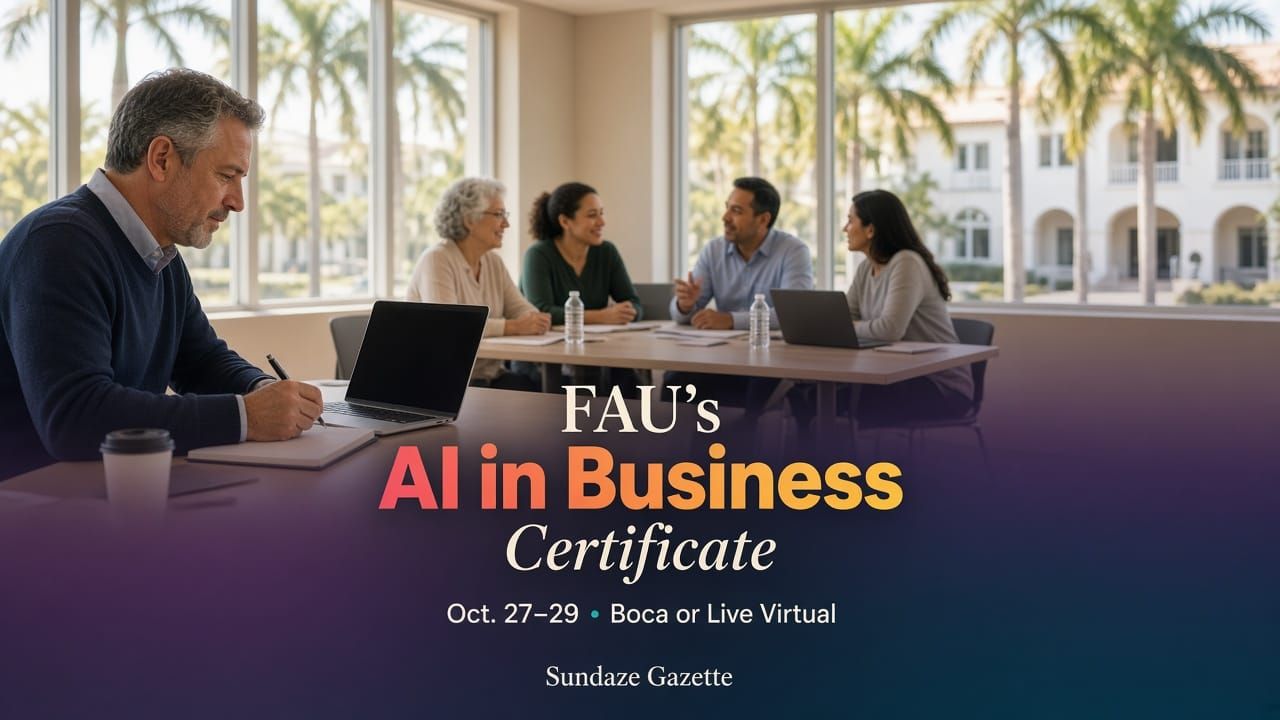
Florida Atlantic University’s Certificate in Artificial Intelligence in Business runs October 27–29, 2026 — Tuesday, Wednesday and Thursday — from 8:30 a.m. to 4:00 p.m. Eastern each day. FAU offers the same intensive on campus in Boca Raton or live virtual. The published price is $2,495. The university lists it as 24 hours and 2.4 CEUs.
That is not a lunch-and-learn. It is protected time — rare for people who still answer customer texts during dinner — aimed at mid-level managers through executives who need a shared language for AI before they approve another tool, another vendor pitch, or another half-finished “we should use ChatGPT” experiment inside the company.
The question hanging over the registration page is not whether artificial intelligence matters. Most owners already feel that pressure. The question is whether three consecutive days and a four-figure tuition bill are the right next move for the person who will walk into that room — and whether the company is ready to do something with what comes out of it.
A Boca classroom built for operators, not coders
FAU’s College of Business Executive Education frames the certificate as an introduction to AI concepts and to the practical work of integrating those tools into real businesses. The official course page is blunt on the entry bar that scares people away from most tech programs: no coding experience is required, and a prior college degree is not required. What FAU does expect is comfort navigating online resources and browser applications — the everyday fluency of someone who already runs work through email, cloud drives and web tools.
That framing matters in Broward and Palm Beach. Plenty of shops here already have staff pasting customer language into consumer chatbots after hours. Fewer have a manager who can explain the difference between a generative draft, a predictive forecast, a conversational front desk and a knowledge system that searches the company’s own files — or who can stop a rollout when the risk is wrong.
FAU’s published ideal candidate sits in that gap: professionals with experience in business, technology or a related field; people who can interpret data, judge whether an AI idea is feasible, and talk about it with nontechnical colleagues. From mid-level managers to executives. The person who belongs in the seat is less a job title than a function — the owner who controls budget and policy, the operations lead who knows where work stalls, or the senior manager who will have to explain the decision to employees and customers afterward.
What three days are supposed to change
The curriculum FAU publishes is deliberately wide. It opens with why AI matters from startups through mainstream organizations, then moves into how different model families land inside companies. The course names generative, predictive, conversational and knowledge AI — a useful separation for anyone tired of treating “AI” as a single purchase.
It covers the difference between machine learning and deep learning; supervised, semi-supervised and unsupervised learning; and language models including OpenAI, Anthropic, Galactica and others. It spends time on the hallucination problem of large language models — the managerial fact that a fluent answer can still be wrong — and on how Google, Amazon and Microsoft open doors into AI products. Labs listed on the course page include Microsoft Copilot, Google Bard and Amazon Q, plus a look at AWS, Google and Microsoft tools in action, APIs, and building a virtual assistant.
Then the program turns outward: applications in business analytics, finance, accounting, healthcare, logistics and supply chain, sports, consumer products, real estate and legal work. It closes with next-generation trajectory, ethics, the value of data, and organizational readiness from culture to skills.
Read as a feature, not a brochure, that last piece is the hinge. A tool can be bought in an afternoon. Agreement on review responsibility, customer disclosure, data boundaries and staff training is management work. The certificate’s claim is not that three days mint a data scientist. It is that an operator can leave with enough structure to stop buying on vibes.
Past participants quoted on FAU’s page describe the experience in practical language — complex ideas made graspable without a technical background, books and speakers that stuck, a boost in efficiency and collaboration. Those are testimonials, not guarantees. The useful takeaway for a local owner is the posture FAU is selling: business application over code drills.
The faculty voice in the room
FAU lists Dr. Mehran Basiratmand as the instructor. His university profile describes a C-level IT executive background across higher education, healthcare, local and state government, and large enterprises — organizational transformation, enterprise architecture, cybersecurity, cloud migration, the Microsoft stack, and the slower art of building teams that can actually use what gets bought. FAU lists his Ph.D. in Educational Leadership from Florida Atlantic University.
For an owner deciding whether to spend $2,495, faculty fit is part of the story. This is not marketed as a celebrity keynote. It is an executive-education classroom with a practitioner who has lived the messy middle between strategy decks and delivery. That matches the audience FAU says it wants: people who need to translate AI into operations, not people hunting for a weekend coding sprint.
Program questions route through Paige Pavlik Garrido, Assistant Director, at 561-297-4819 and PGarrido@fau.edu — the contact FAU publishes for Executive Education on the course page. Format details, documentation of the certificate and CEUs, accessibility, cancellation or transfer terms: those are the kinds of answers worth getting before checkout if they will decide whether the company enrolls.
The calendar pressure before October 27
From mid-September into October, South Florida’s AI education ladder is not empty. Owners who are still testing whether they need a paid intensive already have lighter rooms on the map.
In Palm Beach County, the Greater Delray Beach Chamber’s Chasing AI Session 1 lands on October 16 — a shorter morning built for owners and operators in the roughly 5-to-50-employee band. The Gazette’s Delray Chamber Chasing AI guide is the light prep for that room. It is not a substitute for FAU’s three-day certificate. It is a chance to hear the accountability questions out loud before anyone puts tuition on a card.
Operators willing to drive south can weigh FIU Business’s AI 305 conference on October 2 at the Graham Center — a denser one-day Miami program of panels, workshops and networking. The Gazette’s FIU AI 305 owner guide covers that day on its own terms. Ticket pricing lives on FIU’s live registration surface; treat it as a separate product from FAU’s certificate, not a free twin and not the same three-day management sequence.
Free public literacy still sits under both. The Gazette’s Broward Library and SCORE AI literacy ladder remains the low-friction place to form better questions. Founders whose real need is venture development rather than AI management education should look at FAU’s Runway Venture Program apply map instead — different problem, different door.
The rhythm for a serious operator is simple enough to say in one breath: use a free or short room to sharpen the question; choose FAU’s October intensive when the company already has a use case, an attendee with authority, and calendar space after October 29 to act.
Boca or live virtual — same syllabus, different tradeoffs
FAU and the registration page present a genuine fork: show up on campus or join live virtually. The curriculum is the same published product either way. The tradeoff is human.
An on-campus seat in Boca buys distance from the ordinary workday — harder for a ping to pull you out of the room, easier for peer conversation between sessions. Live virtual removes the drive and may be the only honest option for an owner whose shop cannot spare the commute across three consecutive days. Neither format works if the class becomes background audio while email stays open. The published hours are full days. Treat them that way or do not enroll.
The registration surface for Fall 2026 lists Artificial Intelligence in Business (Live Virtual or On Campus) for October 27–29 and shows a $2,495 program registration charge with a $2,495 grand total. FAU’s professional-development calendar carries the same October 27 start for the Certificate in Artificial Intelligence in Business, marked on campus or live virtual. Confirm those pages before you rearrange a week of payroll and meetings.
What the company should bring into the room
The strongest version of this certificate is not a spectator sport. It is a management intervention with a short fuse.
Owners who get value from programs like this usually arrive with something specific: a proposal-writing bottleneck, a knowledge-search mess, a repetitive intake queue, an inventory forecast that still lives in a spreadsheet someone distrusts, an accounting workflow that burns the same afternoon every month. One primary use case and one backup beat a vague ambition to “learn AI.”
They also arrive with a data boundary already written down — customer records, health information, employee files, contracts, credentials, unpublished financials, proprietary work — the list of things that do not get pasted into an unapproved tool during a classroom exercise. Sanitized or fictional examples travel farther than a live customer file that should never have left the shop.
And they leave with a decision log, not a stack of slides: possible use, expected benefit, risk or dependency, next test. Within a couple of days after October 29, the useful move is a short leadership brief and one narrow, reversible pilot with one accountable person and one measurable outcome — not a silent handoff of hiring, credit, medical or legal decisions to a model because the demo looked smooth.
None of that is FAU’s published syllabus. It is the company work that turns a professional-development certificate into an operating choice. Without it, $2,495 buys awareness. With it, three days can become the shared vocabulary a leadership team has been missing.
The decision that actually matters
South Florida does not lack AI conversation. It lacks owners who can say, in plain language, which category of tool fits a problem, what evidence would justify adoption, who checks the output, and what the company will refuse to automate.
FAU’s October certificate is one concentrated answer to that gap: three days, Boca or live virtual, a published $2,495 price, no coding requirement, no prior-degree gate, a curriculum that runs from model types and major providers through labs, vertical examples, hallucinations, ethics and organizational readiness, led by Dr. Mehran Basiratmand.
It is the right rung when curiosity has already burned off and sales demos are no longer enough — when someone with authority can clear the calendar, protect the company’s data, and schedule the November meeting that decides what happens next. If those pieces are missing, start with a shorter local room and build them. If they are in place, confirm the live details with FAU, choose the format that lets you stay present, and treat October 27–29 as workdays that belong to the future shape of the company.
Key Facts for Owners and Search
Verified from FAU Executive Education primaries (course page, professional-development calendar, and Fall 2026 registration), checked September 17, 2026.
- Program: Certificate in Artificial Intelligence in Business — FAU College of Business Executive Education
- Dates: October 27–29, 2026 (Tuesday, Wednesday, Thursday)
- Hours: 8:30 a.m.–4:00 p.m. Eastern each day
- Sessions: 3
- Format: On campus (Boca Raton) or live virtual
- Price: $2,495 (registration page shows $2,495 program charge and $2,495 grand total)
- Duration / credit: 24 hours / 2.4 CEUs
- Coding required: No
- Prior college degree required: No (solid browser / online-resource fluency expected)
- Ideal candidates (as published): Mid-level managers through executives; professional experience in business, technology or related fields; analytical and communication ability for AI feasibility and stakeholder explanation
- Curriculum highlights (as published): Generative, predictive, conversational and knowledge AI; machine learning vs. deep learning; supervised / semi-supervised / unsupervised learning; language models including OpenAI, Anthropic, Galactica and others; LLM hallucination problem; Google / Amazon / Microsoft access paths; labs including Microsoft Copilot, Google Bard, Amazon Q; APIs and virtual assistant; AWS / Google / Microsoft tools; vertical applications in analytics, finance, accounting, healthcare, logistics & supply chain, sports, consumer products, real estate and legal; ethics, data value and organizational readiness
- Faculty: Dr. Mehran Basiratmand
- Contact: Paige Pavlik Garrido, Assistant Director — 561-297-4819 — PGarrido@fau.edu
- Primary course page: https://business.fau.edu/executive-education/professional-development/course-offerings/business-and-data-analytics/artificial-intelligence-in-business/
- Professional development calendar: https://business.fau.edu/executive-education/professional-development/calendar/
- Fall 2026 registration: https://go.execed2.fau.edu/events/panel-and-networking2/business-technologies-data-analytics/artificial-intelligence-in-business/fall2026/sec100
Related Gazette context (separate products; confirm live pages before travel or purchase): Delray Chamber Chasing AI Session 1 — Oct. 16; FIU Business AI 305 — Oct. 2; Broward Library–SCORE AI literacy ladder; FAU Runway Venture Program apply map.