

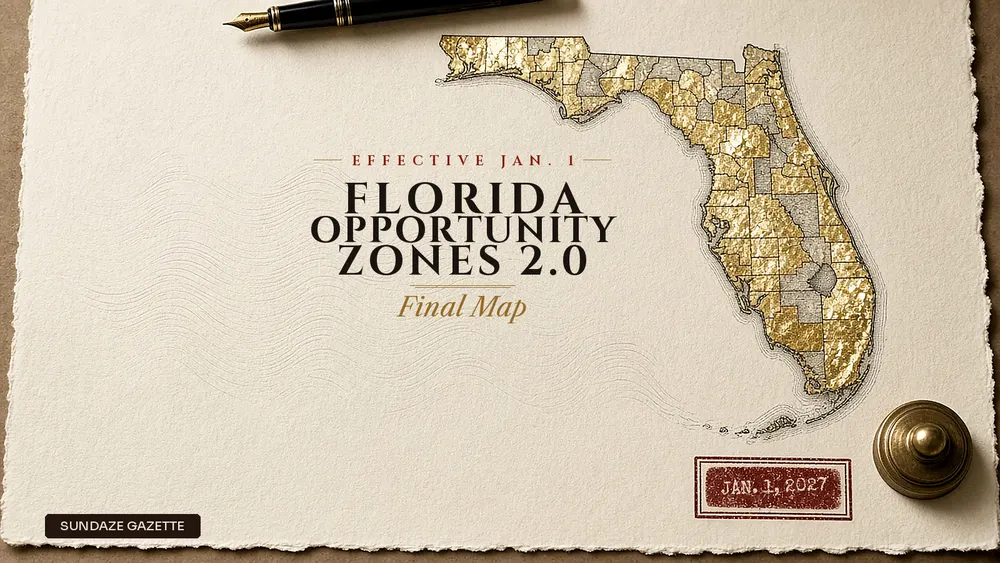
The wait for Florida's Opportunity Zone 2.0 map is over. On Nov. 5, 2026, the U.S. Treasury and the IRS announced Opportunity Zone designations for all 50 states, the territories and the District of Columbia. All 6,576 nominated census tracts were designated as qualified Opportunity Zones, and the new zones take effect Jan. 1, 2027, for ten years.
The official list and map are posted on the CDFI Fund's Opportunity Zones page, which Treasury named as the source for designated tracts. Owners can download the official spreadsheet or use the map linked from that page to check a 2020 census tract against the final designations.
Treasury designated Florida's 342 Opportunity Zone 2.0 tracts on Nov. 5, 2026, including 98 rural tracts. They take effect Jan. 1, 2027, and run through Dec. 31, 2036. A property is in a new zone only if it sits in one of those certified tracts, which owners should confirm on the official CDFI list or map before signing a deal that depends on the tax break.
A property owner in Little Haiti, a landlord on a Broward commercial strip and a family office in Palm Beach are no longer waiting on the same list. They can now look up a parcel on the federal map and see whether it carries the tax break from 2027 through 2036.
Is My Property in a Florida Opportunity Zone 2.0?
Start with the parcel's 2020 census tract, then match that tract to the CDFI Fund's official designated list. The list uses 2020 tract boundaries, and those lines stay fixed for the ten year designation period. A street address alone is not enough, because zone status is set at the tract level.
Two older maps will mislead owners who stop there. Sitting in a 2018 Opportunity Zone does not carry over. Appearing on Treasury's earlier eligible tract file, updated Sept. 23, 2026, only meant a tract could be nominated, not that it made the final map.
Palm Beach County published its 15 designated tract numbers in a Nov. 10 county release on the state's Opportunity Zone nominations. County totals help with context, but owners should still confirm the individual tract on the federal list.
What Opportunity Zone 2.0 Is
The Opportunity Zone program gives tax incentives to investors who put capital gains into designated low income census tracts through a qualified opportunity fund. Congress made the program permanent in 2025 through Public Law 119-21 and set up a new selection round every ten years, according to a Congressional Research Service FAQ on the Round Two selection process.
The first round of zones, picked in 2018, is often called Round One. The new round, Round Two, covers Jan. 1, 2027, through Dec. 31, 2036. CRS notes that most 2018 zones are scheduled to lose their designation at the end of 2028, so 2027 and 2028 are an overlap period when both maps matter.
How Many Florida Tracts Made the Final Map
The CDFI Fund's official designated spreadsheet, posted with Treasury's Nov. 5 announcement, lists 342 Florida census tracts, including 98 rural and 244 non-rural tracts, across 63 counties. The largest county counts are 51 in Miami-Dade, 25 in Hillsborough and 21 in Broward.
Those 342 designations match Florida's statutory cap. Treasury's eligible tract file, updated Sept. 23, 2026, listed 1,367 Florida low income census tracts, including 284 classified as entirely rural. Under IRS Revenue Procedure 2026-14 on nominating 2027 Opportunity Zones, a state may designate no more than 25 percent of its eligible tracts, with fractions rounded up. That ceiling was 342, and Florida used it in full.
In South Florida, the eligible file had listed 247 tracts in Miami-Dade County, 101 in Broward County and 71 in Palm Beach County. The final map is narrower: 51, 21 and 15, respectively.
Palm Beach County says Gov. Ron DeSantis nominated 15 county tracts, and that 14 of the 15 were among the 20 tracts the Palm Beach County Board of County Commissioners recommended in March 2026. The designated Palm Beach County census tracts, matching both the county release and the official CDFI list, are 14.02, 15.00, 16.00, 24.00, 38.02, 40.07, 40.09, 45.00, 48.19, 52.03, 52.04, 61.00, 80.02, 83.01 and 83.02. The official list classifies 80.02, 83.01 and 83.02 as rural. The county points owners with questions to Meri Weymer at 561-233-3675.
How a Tract Qualifies
Revenue Procedure 2026-14 spells out the low income test used for nomination. A census tract inside a metropolitan area qualifies if its median family income is no more than 70 percent of the metro area median, or if its poverty rate is at least 20 percent and its median family income is no more than 125 percent of the metro median. Tracts outside a metro area use the statewide median instead.
Treasury built its eligible list from the 2020 to 2024 American Community Survey five year data, using 2020 census tract boundaries. Those boundaries are fixed for the full designation period, so a zone line will not move during the ten years even if neighborhoods change.
Two eligibility changes still matter for owners who were in a 2018 zone. Contiguous tracts, which some states used in Round One, could no longer be nominated, so each tract had to qualify as low income on its own. A 2018 zone also did not carry over. The tract had to meet the new test based on 2020 to 2024 Census data, then be nominated and designated.
Florida in Round One
For context, the CRS FAQ, drawing on CDFI Fund records, shows Florida had 427 Opportunity Zones selected in Round One. CRS also lists Florida among the states that did not nominate any contiguous tracts in that round. The Round Two map is smaller, at 342 tracts, and it was drawn from a different pool than the 2018 map because the income test now uses newer Census data.
What Treasury Announced on Nov. 5
Under Revenue Procedure 2026-14, Treasury had a 30 day consideration period after the Oct. 28 nomination deadline, ending Nov. 27, 2026, at the latest, or Dec. 28 if a state requested a 30 day extension. Treasury and the IRS did not wait until that outer date. On Nov. 5 they designated all 6,576 nominated tracts, including 2,594 rural tracts, effective Jan. 1, 2027.
Treasury posts underlying tract data on its Qualified Opportunity Zones data page. The FloridaCommerce Opportunity Zones page remains the state's program page. As of Nov. 2, 2026, it had not posted a public nomination list. Owners can email the state at opportunityzones@commerce.fl.gov.
Dates That Still Matter on the New Map
Four dates still apply now that the Florida map is final. They come from IRS Notice 2026-40, transitional guidance for Opportunity Zone investors and funds, and from Revenue Procedure 2026-14.
Dec. 31, 2026: Old Deferred Gains Come Due. Gain deferred through an investment made on or before Dec. 31, 2026, is included in income in the year that includes the earlier of an inclusion event or Dec. 31, 2026. Investors who still hold such an investment on that date must include the remaining deferred gain for 2026, and that deemed included gain cannot be deferred again into a new fund. A Florida investor may owe tax on that gain for 2026 even if the fund stake is kept, so plan cash for the bill.
Jan. 1, 2027: New Investments Get a Rolling Five Year Deferral. Under the notice, eligible gain realized before or after Dec. 31, 2026, and timely invested in a qualified opportunity fund on or after Jan. 1, 2027, can be deferred until the earliest of a sale, another inclusion event or five years from the investment date. Timely generally means within 180 days of the event that produced the gain, so investors weighing late 2026 against early 2027 should run both paths with a tax adviser.
After Dec. 31, 2026: Property Purchases Follow the New Map. Tangible property a fund or zone business buys after Dec. 31, 2026, must be purchased after the start date of the zone where it is used, which is Jan. 1 following that zone's certification. A 2018 zone has no such start date, so property bought after Dec. 31, 2026, for use there generally does not qualify, with two exceptions:
- A written working capital plan adopted on or before Dec. 31, 2026, where the business has received at least 10 percent of the planned working capital and spent at least 5 percent by that date. Amounts owed under a binding agreement signed before Jan. 1, 2027, count toward the 5 percent.
- Ordinary course replacements needed to keep operating, such as new appliances and flooring in apartment units or a new kitchen ventilation system in a restaurant, two examples the notice uses. Expansions and moves into a new line of business do not count.
Dec. 31, 2028: The 2018 Map Ends. Revenue Procedure 2026-14 and Notice 2026-40 give Dec. 31, 2028, as the end date for most 2018 zones, and FloridaCommerce has said Florida's 427 Round One zones expire that day. Zones designated in 2026 run from Jan. 1, 2027, through Dec. 31, 2036.
What the New Tax Break Looks Like
The CRS FAQ, citing the Internal Revenue Code, describes the Round Two investor terms:
- Capital gains reinvested in a qualified opportunity fund can be deferred until the earlier of a sale or five years after the investment.
- The basis in the reinvested gain rises by 10 percent for investments held at least five years.
- That step up is 30 percent for investments in a qualified rural opportunity fund, which holds at least 90 percent of its assets in entirely rural zones.
- Gains on the zone investment itself can be excluded from income if it is held at least 10 years.
Some businesses never qualify, including golf courses, country clubs, massage parlors, hot tub or suntan facilities, gambling establishments and liquor stores.
What Counts as Zone Property
The CRS FAQ lists three ways a fund can invest: buying stock in an Opportunity Zone business, buying a partnership interest in one, or holding Opportunity Zone business property directly. Direct property must be tangible, located in a zone, and either put to first use by the business or substantially improved.
For South Florida owners, that last point is the practical one. A building or lot inside a certified tract does not deliver the benefit by itself. The value usually comes when a fund buys and improves the property, or backs a business that operates there.
Owner and Investor Next Steps
- Look up your parcel's 2020 census tract and check it against the CDFI Fund's official designated list or map. A tract that is not on that list is not a 2027 Opportunity Zone.
- If your property sat in a 2018 zone, plan around the end of 2028 and confirm whether the tract was designated again under the new data.
- If you hold a 2018 fund investment, mark Dec. 31, 2026, and plan cash for the deferred gain that comes due.
- If a project in a 2018 zone depends on purchases in 2027 or later, confirm a written working capital plan was adopted, funded at 10 percent and spent at 5 percent by Dec. 31, 2026.
- Pair Opportunity Zone planning with state and local programs in the South Florida business grants and incentives guide.
- Talk with a tax adviser before moving gains into a fund. Fund rules, holding periods and the 90 percent asset test all affect the outcome.
- Owners with land or buildings in a designated tract may hear from fund sponsors early in 2027. Have current valuations and improvement plans ready.
For a local example of how funds are forming, read about a Homestead startup's Opportunity Zone fund. Investors tracking capital flows can also use the South Florida economic owner map.
Sources
- U.S. Treasury and IRS, Opportunity Zones designations for over 6,500 communities (Nov. 5, 2026)
- CDFI Fund, Opportunity Zones page, official designated list and map (list posted with the Nov. 5 designations)
- CDFI Fund, official spreadsheet of designated Qualified Opportunity Zones (final_oz2_designations.xlsx)
- Palm Beach County, Governor DeSantis nominates 15 Palm Beach County census tracts for Opportunity Zones 2.0 (Nov. 10, 2026)
- IRS Revenue Procedure 2026-14, nominating 2027 Qualified Opportunity Zones
- U.S. Treasury, Qualified Opportunity Zones data and eligible tract file (Sept. 23, 2026)
- Congressional Research Service, Opportunity Zones Round Two Selection Process FAQ (R48952)
- IRS Notice 2026-40, Transitional Guidance on Qualified Opportunity Zones
- FloridaCommerce, Opportunity Zones program
Related
- Homestead Startup Launches Opportunity Zone Fund
- Palm Beach Office Construction Surges 400 Percent
- South Florida Economic Buzz Owner Map
Key Facts for Owners and Search
When did Treasury designate Florida's Opportunity Zones 2.0?
On Nov. 5, 2026, the U.S. Treasury and the IRS announced Qualified Opportunity Zone designations for all 50 states, the territories and the District of Columbia. All 6,576 nominated census tracts were designated. The new zones take effect Jan. 1, 2027, and run for ten years, through Dec. 31, 2036. Florida's designated tracts appear on the CDFI Fund's official list and map.
How many Florida census tracts are on the final Opportunity Zone 2.0 map?
The CDFI Fund's official designated list counts 342 Florida tracts, of which 98 are classified as rural and 244 as non-rural. In South Florida, the same file lists 51 tracts in Miami-Dade County, 21 in Broward County and 15 in Palm Beach County. Those 342 tracts equal Florida's 25 percent cap on the 1,367 eligible tracts in Treasury's Sept. 23, 2026, file.
Is my property in a Florida Opportunity Zone 2.0?
A property is in a new zone only if it sits in one of the 342 census tracts on the CDFI Fund's official designated list, using 2020 tract boundaries. Look the parcel up on the CDFI Opportunity Zones page, which hosts the list and a map. A 2018 zone, or a listing only on the earlier eligible tract file, is not enough.
What tax benefits do Round Two Opportunity Zones offer?
According to the Congressional Research Service, reinvested capital gains can be deferred up to five years, with a 10 percent basis step up after five years of holding. Qualified rural opportunity funds get a 30 percent step up instead. Gains on the zone investment itself can be excluded from income when the investment is held at least 10 years.
What happens to Florida's 2018 Opportunity Zones and deferred gains?
The Congressional Research Service says most 2018 zones lose their designation at the end of 2028, so the maps overlap in 2027 and 2028. A 2018 tract does not carry over automatically. IRS Notice 2026-40 says gain deferred through an investment made on or before Dec. 31, 2026, must be included in 2026 income and cannot be deferred again into a new fund.
Brian D'Antoni writes The Sundaze Gazette from Palm Beach County. He reports on business, film and technology for South Florida owners.
