By Brian D’Antoni Sundaze Gazette · Business · Sept. 23, 2026
South Florida owners already track local land-use clocks for large loads. The quieter stack — the one that decides whether a project can cash-flow — sits in Tallahassee: a new statewide power-and-water framework for big loads, and a sales-tax exemption that now only opens at hyperscale critical IT load.
If you are a landlord shopping industrial dirt, a contractor pricing shell and MEP, a compute investor underwriting Florida, or an operator comparing a 40 MW colo to a 100 MW campus, you need both layers on one sheet. Senate Bill 484, now Chapter 2026-65, rewires how public utilities must price and protect service for large load customers. Separately, Florida’s data-center sales-tax exemption under section 212.08(5)(r), Florida Statutes — as amended by HB 7031 (2025) — gates tax relief at 100 megawatts of critical IT load and $150 million of cumulative capital investment.
This is the owner stack: thresholds, who pays what, what you verify with the Florida Department of Revenue, and what still sits with your utility and your local zoning desk. It is built to sit beside — not replace — the Gazette’s Palm Beach County hearing checklist at palm-beach-county-large-scale-data-center-moratorium-sep-24-2026. County land-use clocks and statewide money rules are different instruments. Confuse them and you underwrite the wrong risk.
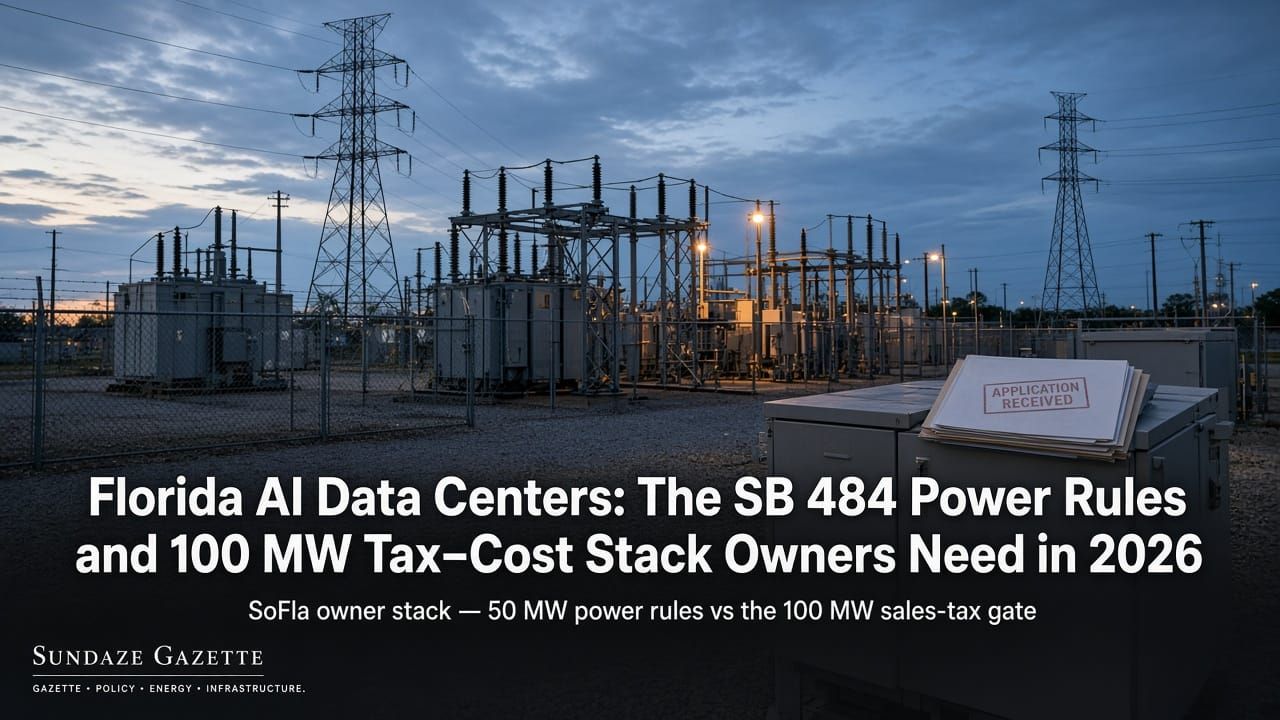
Two Megawatt Lines — Do Not Mix Them Up
Owners keep asking for “the Florida data-center megawatt number.” There are two, and they do different jobs.
Fifty megawatts is the Chapter 2026-65 tripwire. A large load customer is a customer with an anticipated monthly peak load of 50 MW or more, measured as the highest average load over a 15-minute interval at a single location. The statute does not let you aggregate load across multiple sites owned by the same customer to create the label — and it does not let you dodge the label by splitting one site into smaller service connections. Colocation and similar agreements at a single qualifying location count toward the threshold. The same 50 MW single-location definition creates a large-scale data center for consumptive-use permitting under chapter 373.
One hundred megawatts is the sales-tax gate. Under section 212.08(5)(r), “critical IT load” means the electric power capacity reserved solely for owners or tenants to run computer server equipment — not cooling, lighting, common areas, or other ancillary load. To qualify for the data-center property exemption, the facility must reach a critical IT load of 100 MW or higher, with 1 MW or higher dedicated to each individual owner or tenant, and the owners and tenants must make a cumulative capital investment of $150 million or more, all within five years after construction begins. HB 7031 raised the critical IT load floor from 15 MW to 100 MW effective August 1, 2025, and extended the temporary-certificate window so the Department of Revenue may not issue a temporary tax exemption certificate under that paragraph after June 30, 2037.
Owner translation: a project can be a “large load customer” for utility and water rules at 50 MW while still sitting outside the sales-tax exemption until critical IT load hits 100 MW. A sub-50 MW edge box is a different underwriting animal again. Write the two numbers on the term sheet separately.
What Chapter 2026-65 Changes on Power Cost
Chapter 2026-65, enrolled from CS/CS/SB 484, took effect July 1, 2026, for the utility tariff core (with local-government and definition sections effective on becoming law). The policy spine is blunt: when one customer class needs uniquely large electrical load at a single location, the Florida Public Service Commission must enforce rate structures that keep that risk from migrating onto everyone else.
Public utilities — investor-owned electric utilities under chapter 366, not gas utilities — must place minimum tariff and service requirements for large load customers into their tariffs. Those requirements must reasonably ensure each large load customer bears its own full cost of service, including connection, incremental transmission, incremental generation, other infrastructure, operations and maintenance, and other costs required to serve that customer. The risk of nonpayment may not sit on the general body of ratepayers.
To make that real, the Commission may approve industry-accepted ratemaking and financial tools, including:
- Contributions in aid of construction or other required customer infrastructure investments that may be returned, in whole or in part, over time
- Demand charges, including minimum demand charges
- Incremental generation charges
- Financial guarantees
- Minimum load factors
- Take-or-pay or similar pay-for-contracted-capacity terms even when actual use is lower
- Minimum period of service contracts, including early-termination and related fees
Each public utility must file a compliant tariff for Commission approval no later than October 1, 2026. Until your utility’s approved tariff is in hand, treat marketing one-pagers as color, not contract.
Two more power rules matter on day one. First, nothing in the tariff or contract may block curtailment or interruption of service to a large load customer when the utility needs it for grid stability, to limit wider outages, or for public safety in an emergency. Hyperscale reliability marketing and statutory interruption rights can both be true — underwrite both. Second, a public utility may not knowingly provide electric service to a large load customer that is a foreign entity as defined in the act (ownership or control by the government of a foreign country of concern, or organization under the laws of / principal place of business in such a country, including subsidiaries). “Controlled by” includes a presumption at 25 percent or more of voting interests or profits. Counsel should map beneficial ownership early; this is a service eligibility issue, not a branding footnote.
Local governments keep their comprehensive planning and land development authority over large load customers. A large load customer may not be treated as an electric substation for purposes of section 163.3208. That keeps large load customers on the ordinary land-use track; it does not pre-empt county or city land-use power. Palm Beach County’s large-scale data-center process remains a local ULDC problem — which is why the Gazette’s Sep 24 moratorium checklist stays the right desk for unincorporated PBC intake timing.
Water Is Part of the Cost Stack
Chapter 2026-65 also builds a large-scale data center lane into consumptive-use permitting. A water management district or the Department of Environmental Protection may not issue an allocation if the proposed use would harm water resources or if local zoning and the comprehensive plan prohibit the use. A permit shall issue when the applicant shows reasonable-beneficial use, no interference with presently existing legal uses, and consistency with the public interest — the classic chapter 373 tests, now aimed expressly at this facility class.
When reclaimed water is available and permitted, lines are at the property boundary with enough capacity and quality, the applicant can connect, use is environmentally, economically, and technically feasible, and use would not conflict with a surface-water discharge permit, the governing board or department shall require reclaimed water in lieu of all or part of the proposed surface or groundwater use. Applications seeking at least an average daily flow of 100,000 gallons must inventory sources, amounts, and losses for cooling, process, employee, and irrigation uses and attach a conservation plan that at minimum covers cooling-water recycling, leak detection and repair, efficient fixtures, and employee education. Large-scale data center applications may not be approved without a hearing. Modifications proposed by a large-scale data center are treated like initial applications.
For SoFla owners, that means cooling strategy, reclaimed-water adjacency, and CUP hearing calendars belong in the same workbook as interconnection deposits — not in a later “environmental” appendix.
The 100 MW Tax Gate — What the Statute Actually Exempts
The sales-and-use tax exemption for data center property is older than SB 484, but the 2025 rewrite changed who can reach it. Section 212.08(5)(r) exempts data center property from the tax imposed by chapter 212, except the tax imposed by section 212.031. In plain English: qualifying equipment, construction materials, computers, servers, power and cooling gear, enabling software, and electricity used exclusively at the data center can sit in the exemption — commercial rent tax treatment under 212.031 is carved out of this paragraph’s relief.
Eligibility, again, is the triple lock: $150 million cumulative capital investment after July 1, 2017 (with limits on counting acquisition of an already-operating data center), 100 MW critical IT load facility-wide, and 1 MW critical IT load per owner or tenant, all satisfied within five years of construction start. “Data center” under the tax statute means a facility on contiguous Florida parcels used exclusively to house and operate data equipment (or equipment necessary for that operation), built on or after July 1, 2017, and meeting the load tests.
There is no soft landing in the enrolled HB 7031 text for sub-100 MW projects hoping the old 15 MW floor still applies after August 1, 2025. If your critical IT load plan tops out at 20, 40, or 80 MW, underwrite sales tax as a live cost unless and until DOR materials and your tax counsel say otherwise for your facts. Hyperscale and multi-tenant campuses that can honestly certify 100 MW critical IT load — not nameplate rumor — are the population the exemption now fits.
What Operators Verify With DOR — Without Inventing a Filing Fairy Tale
Florida Department of Revenue primary forms are the only filing path this story will name.
To seek a temporary certificate while the project is still proving up, the data center uses Form DR-1214DCP, Application for Data Center Property Temporary Tax Exemption Certificate (R. 01/25 / Eff. 02/25), which expressly cites section 212.08(5)(r). The application asks for project location, construction timing, cost categories, and — critically — the anticipated minimum critical IT load for the data center and for each owner and tenant. Current DR-1214DCP instructions route the application to the Department’s Office of Technical Assistance (mailing address printed on the form) or through the contact path shown on floridarevenue.com.
Once the statutory investment and load tests are met, Form DR-5DCP, Application for Data Center Property Certificate of Exemption, is the DOR application that seeks the ongoing certificate. DR-5DCP requires the applicant to return the temporary certificate and to attach independent certifications: a Florida-licensed professional engineer on critical IT load, and a Florida CPA on the $150 million cumulative capital investment, under the independence limits in the statute. The form text names the issued credentials as a Data Center Property Temporary Tax Exemption Certificate (Form DR-14TDCP) and a Data Center Property Certificate of Exemption (Form DR-14DCP). Purchasers, tenants, and contractors who buy under the exemption need a copy of the certificate plus a signed certificate of entitlement at purchase; self-accrual accounts keep their own proof.
Noncompliance is not a slap on the wrist. If DOR determines purchases did not qualify, tax that was avoided becomes due with penalty and interest from the purchase date, and the assessment window for that clawback is extended. Permanent certificates remain subject to five-year review, with a written declaration that the critical IT load tests still hold.
Owner discipline: download current PDFs from floridarevenue.com, confirm the revision date, and have tax counsel and your PE/CPA team read the statute and the form together. Do not treat a blog’s form checklist as a substitute for the PDF in your hands. If a form’s checkbox language still trails the 100 MW statute, ask DOR in writing which instruction controls — do not guess.
Who This Hits in South Florida
Landlords and land sellers marketing “AI-ready” or “data-center adjacent” parcels should separate listing claims into power class (sub-50, 50–99.9, 100+ critical IT), water/reclaimed adjacency, and local zoning lane. A glossy MW number without a utility load letter and a cooling story is a lawsuit waiting for a sophisticated buyer.
Contractors and MEP firms should expect heavier CIAC, guarantee, and schedule risk on 50 MW+ interconnects after utilities file the October 2026 tariffs — and should price tax-exempt purchasing protocols only where a real DOR certificate chain exists.
Colo and compute investors should model three cases: (1) sub-50 MW, outside the large-load tariff class but also outside the tax exemption; (2) 50 MW+ large load, full cost-of-service tariff exposure, still below 100 MW critical IT load; (3) 100 MW+ critical IT load with a live DOR certificate path. Blurring those cases is how term sheets lie.
Municipal vs unincorporated still matters for land use. Chapter 2026-65 does not replace city commission hearings in Boca, West Palm, or Fort Lauderdale, and it does not decide Palm Beach County’s ULDC pause. Use the statewide stack for power, tax, and CUP; use local packets for zoning.
Owner Checklist — Power, Tax, Water, Local
- Write anticipated monthly peak load (15-minute) and critical IT load as two different figures; get engineer paper, not marketing slides.
- Flag whether the site is likely a large load customer / large-scale data center at ≥50 MW.
- Ask the serving public utility for the current large-load tariff status and the utility’s plan for the October 1, 2026 compliant filing.
- Price CIAC, demand, incremental generation, guarantees, load-factor, take-or-pay, and minimum-term tools as live until the approved tariff says otherwise.
- Run beneficial-ownership screening against the foreign entity service bar before you deposit serious interconnect money.
- For tax: if you intend to claim section 212.08(5)(r), map the path through DR-1214DCP → temporary certificate → DR-5DCP with PE and CPA certifications → five-year reviews; confirm current forms on floridarevenue.com.
- Stress-test whether 100 MW critical IT load and $150 million cumulative investment are real inside five years — not aspirational.
- Pull CUP feasibility: reclaimed water at the boundary, 100,000 gpd hearing triggers, conservation-plan contents.
- Keep local zoning on a separate track; in unincorporated Palm Beach County, pair this stack with the Gazette’s large-scale moratorium checklist.
- Calendar OPPAGA’s large-scale data center study due July 1, 2027 — more state policy may follow.
What This Story Is — and Is Not
This is a statewide owner desk on money and rules: 50 MW large-load power and water law under Chapter 2026-65, 100 MW critical IT load sales-tax law under section 212.08(5)(r), and the DOR forms operators actually use. It is not a substitute for utility counsel, tax counsel, or land-use counsel. It is not a post-hearing autopsy of Palm Beach County’s Sep 24 ordinance, and it is not a defense-tech map.
Florida just made the easy story harder — and clearer. If you cannot carry your own power costs, you should not expect other ratepayers to. If you cannot reach 100 MW of critical IT load with real capital behind it, you should not underwrite a hyperscale tax holiday. Put both truths on the same page before you rename a warehouse an AI campus.
Key Facts for Owners and Search
- Chapter 2026-65 (CS/CS/SB 484): large load / large-scale data center framework; utility core effective July 1, 2026; tariffs due Oct 1, 2026
- Large load customer: ≥50 MW anticipated monthly peak at one location (15-minute peak); no load-splitting to avoid class
- Cost rule: large load customers bear full cost of service; no shift to general ratepayers
- Tax statute: §212.08(5)(r) data center property; HB 7031 (Ch. 2025-208) effective Aug 1, 2025
- Tax thresholds: ≥100 MW critical IT load; ≥1 MW per owner/tenant; ≥$150M cumulative capital investment within 5 years of construction start
- Temporary certificates: DOR may not issue under this paragraph after June 30, 2037
- DOR forms (primary): DR-1214DCP (temporary application); DR-5DCP (certificate application); certificates named on DR-5DCP as DR-14TDCP / DR-14DCP
- Water: reclaimed-water mandate when feasibility tests met; ≥100,000 gpd ADF extra application content; hearing required
- Local land use: preserved; large load ≠ electric substation under §163.3208
- Companion Gazette desk: Palm Beach County large-scale moratorium Sep 24 owner checklist (local process — not this statewide stack)