By Brian D’Antoni
Sundaze Gazette · Sept. 24, 2026
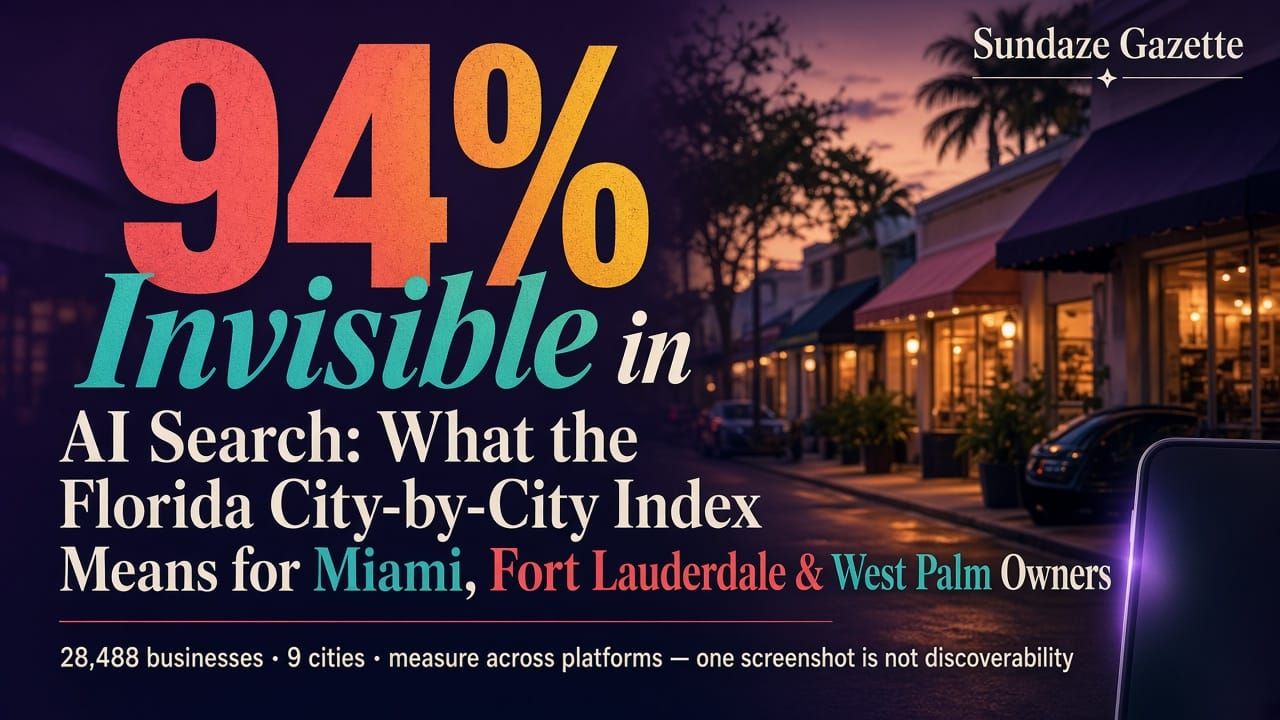
If you run a shop in Miami, Fort Lauderdale, or West Palm Beach, the expensive mistake this month is treating a single ChatGPT mention as proof you are “on AI.” A September 2026 statewide benchmark from Tampa-based Evoke Strategy—Florida AI Visibility 2026: City-by-City Index—tested how almost thirty thousand Florida businesses show up when buyers ask AI tools for local recommendations. The headline number is blunt: 94% of the businesses researched did not appear in any of the AI searches tested. Among the minority that did surface, visibility was often thin, platform-narrow, and easy to over-read as a ranking win.
This is a magazine investigation that ends in an owner checklist. It is not a conference badge map, not a Miramar lab RSVP sheet, and not a sales pitch for any agency product. The Gazette already owns hands-on and event prep pages for October AI clocks; this piece translates the published study frame so South Florida operators can self-locate, measure without self-flattery, and decide what citation-worthy local work actually looks like before they spend.
Canonical sources re-verified live for this package:
- PRWeb / Evoke Strategy release — Comprehensive AI Study Shows 94% of Florida Businesses Studied Have No Visibility in AI Search (September 16, 2026)
- Florida Trend — AI Study Shows 94% of Florida Businesses Studied Have No Visibility in AI Search (September 16, 2026)
- Business Observer — Study: Most Florida businesses are invisible in AI searches (September 18, 2026)
Soft-link only—do not treat this story as a rewrite of the live Miramar lab map: The Gator Effect: Google + AI Visibility Lab — Free Owner Map for Oct. 3, 2026 (Miramar / FIU I-75). That page is the Saturday clinic. This one is the statewide measurement frame.
Owner rule before anything else: one appearance is not consistent discoverability. Measure across questions and platforms, or you will congratulate yourself on a screenshot that does not survive the next buyer prompt.
What the Florida City-by-City Index actually measured
The study name in the release is Florida AI Visibility 2026: City-by-City Index. It benchmarked 28,488 businesses across nine Florida cities and 18 industries, then tested three types of buyer questions across four AI platforms. That design produces 12 searches per industry per city—three questions times four platforms—not a single vanity query.
Cities named in the study set: Tampa, St. Petersburg, Miami, Fort Lauderdale, West Palm Beach, Orlando, Jacksonville, Fort Myers, and Naples. Industries named: Architecture, Commercial Real Estate, Electrical, Engineering, General Contractors, HVAC, Pest Control, Plumbing, Roofing, Assisted Living, Chiropractors, Dentists, Veterinary Practices, Business Consultants, CPA Firms, Insurance, Personal Injury Law, and Staffing & Recruiting.
Statewide search math published with the study:
- 3 buyer questions × 4 AI platforms = 12 searches per industry/city
- 12 searches × 18 industries = 216 searches per city
- 216 searches × 9 cities = 1,944 searches statewide
The four platforms named are ChatGPT, Claude, Gemini, and Google AI Overviews. The release and trade coverage both stress that this is a point-in-time snapshot—useful for patterns, not a permanent ranking of businesses, industries, cities, or platforms. AI answers change when models update, when the question wording changes, and when the shortlist length stays short even if hundreds of firms could fit.
Business Observer’s reporting adds how researchers framed the three question types: a broad search for the “best” local businesses; a direct request for a recommendation; and a question describing a more specific need. That ladder matters for owners who only ever test their exact brand name. Brand recall is not the same job as category discovery.
Devon Vocke, co-founder of Evoke Strategy, put the Florida frame in plain language in the release: the firm studied Florida because that is where it is based, and it does not claim the gap is Florida-only. The practical line for a Gazette reader is narrower: if your market is Miami–Fort Lauderdale–West Palm, you are inside the city set that was actually tested—not a national inference pasted onto Brickell or Clematis.
Appear once ≠ consistent discoverability
The visibility gap is not only “missing vs present.” It is also “present once vs repeatedly findable.”
Just 1,676 businesses—5.9%—appeared at least once in the AI searches tested. Among those that appeared:
- 43.2% appeared in just one of the 12 searches
- 22.4% appeared in two searches
- 21.5% appeared in three or four searches
- 12.9% appeared in five or more searches
Nearly two-thirds of the businesses that surfaced did so in only one or two of the twelve searches run for their industry and city. That is the study’s own warning label: seeing your company recommended in ChatGPT is already ahead of many competitors, but one result does not equal strong AI visibility. The bigger question—again from the published quote—is whether the company is repeatedly discoverable across the questions customers ask and the platforms they use.
For a South Florida owner, translate that into a Monday test. Do not stop after one happy screenshot. Run the category question, the recommendation ask, and a specific-need prompt. If you only win the branded query and disappear when a buyer describes a roof leak in Wilton Manors or a CPA near Downtown West Palm, you do not have consistent discoverability—you have a flattering coincidence.
Platform-split: one AI answer is not four
The second trap is platform theater. Among businesses that appeared at least once:
- 58.7% appeared on only one of the four AI platforms tested
- 24.3% appeared on two
- 11.3% appeared on three
- 5.7% appeared across all four
Few businesses showed up on every platform in the set. The release’s conclusion for marketers is the one that should change your measurement habit: be cautious about using a single search on a single AI platform as a measure of overall AI visibility. A business can show up for one question on one platform and be absent when the question or platform changes.
Owner translation for Miami–Broward–Palm Beach: if your marketing vendor screenshots Claude and calls the job done, ask for the same three buyer questions on ChatGPT, Gemini, and Google AI Overviews—or admit you are buying a story about one pane of glass. If your own lunch-break test lives only inside the app you personally like, you are measuring your habits, not your customers’.
Where Miami, Fort Lauderdale, and West Palm Beach sit in the frame
Miami, Fort Lauderdale, and West Palm Beach are explicitly inside the nine-city index. That is the SoFla cut that matters for this Gazette: you are not reading a Tampa-only study and pretending Brickell inherits the chart.
What the free press abstracts do not publish as a clean league table is a Miami-vs-Fort Lauderdale-vs-West Palm Beach visibility percentage. Business Observer reports that results varied widely by region, with Naples, Fort Myers, and St. Petersburg on the higher side and Tampa on the lower side. It does not hand owners a published SoFla city ranking to paste into a pitch deck. Do not invent one.
What you can say honestly: your city was in the benchmark set; statewide, most studied businesses did not appear; among those that did, consistency across questions and platforms was uncommon; city-level and industry-level detail lives in the full report the firm points to beyond the release. Use the statewide pattern as a diagnostic frame, then measure your shop against the same 12-search logic instead of borrowing another city’s vibe.
Corridor reality still matters without fake percentages. A service-area plumber who works Miami-Dade and Broward is not the same entity problem as a single-storefront dentist on Federal Highway. Multi-city operators should run the buyer questions the way customers actually speak—“near me,” named neighborhood, named city—not only the legal Sunbiz city line.
Industry self-locate: find your lane in the 18
If your trade sits in the published 18, start there. The list is the self-locate tool: Architecture; Commercial Real Estate; Electrical; Engineering; General Contractors; HVAC; Pest Control; Plumbing; Roofing; Assisted Living; Chiropractors; Dentists; Veterinary Practices; Business Consultants; CPA Firms; Insurance; Personal Injury Law; Staffing & Recruiting.
Business Observer’s industry cuts—reported from the study—are useful as order-of-magnitude context, not as a shame scoreboard:
- Veterinary practices: 148 of 772 businesses, or 19.2%, appeared at least once (highest of the 18 in that reporting)
- Pest control: 17.5%
- Commercial real estate: 13.8%
- Dentists: 3.6% of 4,509 studied
- Insurance: 2.6% of 3,975
- General contractors: 2.3% of 3,713
- Business consultants: 2.4%
The same reporting notes a blunt pattern: the larger the industry sample, the worse businesses tended to fare on visibility rate—crowded categories still get short AI shortlists. That is not a moral judgment on dentists or contractors. It is a reminder that AI answers are compressed recommendation sets, not Yellow Pages dumps.
If your business is outside the 18 (restaurants, retail boutiques, creators, film vendors, most consumer services), do not fake a study percentage. Borrow the method: three buyer-style questions, four platforms, “appear once ≠ consistent,” then build entity clarity the same way the indexed trades need it. The study is a Florida pattern instrument, not a claim that only those 18 industries matter in AI search.
How to use a free checker without buying a story about yourself
The release states that Evoke Strategy offers a free AI Visibility Checker for companies looking to understand how their business appears in AI search. A free check can be a useful first pass. It is not a substitute for the study’s 12-search design, and it is not an endorsement of any paid retainer.
Owner rules that keep the tool in its lane:
- Treat output as a snapshot, not a trophy. The study itself warns that AI responses change with platform updates, wording, and shortlist length.
- Re-run with your own prompts. Use the three question types Business Observer described—broad “best,” direct recommendation, specific need—in the language your customers actually use for Miami, Fort Lauderdale, or West Palm Beach neighborhoods.
- Compare platforms, not vibes. If a checker surfaces one pane and your manual tests miss another, log the gap. Do not average them into “we’re fine.”
- Do not past customer PII into consumer AI chats while you poke around. Business name, category, and city are enough for a discovery test.
- Separate measurement from shopping. A free check that educates you is fine. A free check that becomes an unexamined sales funnel is your problem to refuse.
If you want a hands-on room instead of a solitary browser tab, that is what the live Gator Effect Miramar lab on October 3 is for—bring the laptop, score gaps, start one fix in the room. This study piece does not replace that Saturday.
Citation-worthy local content and entity consistency for SoFla shops
AI systems do not “owe” your shop a mention because you paid for a logo refresh. They lean on what they can verify: consistent names and addresses, third-party references, clear service-area language, and content that answers the questions buyers actually ask. For South Florida operators, the practical stack is boring on purpose.
Entity consistency first. Legal name, DBA customers type, Google Business Profile, website footer, directories, and invoice header should tell the same story. Phone, hours, and category mismatches are still discovery killers even when the conversation moves from Maps packs into AI answers. If your Fort Lauderdale GBP says one suite and your site says another, you trained two entities.
Citation-worthy local content second. Write pages and posts that a careful stranger could cite: neighborhood + service reality, licensing where it matters, staff credentials that are true, project or case language that does not invent awards. “Best plumber in Miami” fluff is not the same as a clear page on emergency drain work in specific ZIP patterns you actually serve. Machine-readable clarity helps humans too—schema and clean headings are hygiene, not magic.
Authority without theater. Local news mentions, chamber pages, professional association listings, and partner sites that use your real NAP beat a pile of identical AI-generated blog posts. The Gazette’s own doctrine for AI-search measurement stays people-first: no geo hacks, no keyword farms, no fake urgency. If a tactic would embarrass you in front of a customer who already knows your shop, it is the wrong tactic for AI visibility too.
Measure the job that pays. Rank fixes by revenue risk and editability. A wrong phone number outranks a thought-leadership essay you never had time to finish. A missing service-area sentence outranks a sixth Instagram reel about “AI SEO.” Consistent discoverability is a systems problem: identity, proof, and answers in the places buyers already ask.
How this sits next to Gator Effect and the October AI ladder
Do not collapse three different Gazette jobs into one tab.
- This story: statewide study translation + SoFla owner checklist (measurement frame, industry self-locate, entity/content hygiene).
- Gator Effect Oct. 3 Miramar: free hands-on Google + AI visibility lab—Test It / Score It / Fix It on your actual business.
- Conference and literacy maps already live (AI305, Miami AI Summit, Delray Chasing AI, Broward Library–SCORE ladder, and peers): calendars, badges, and question-asking rooms—not a re-statement of Evoke’s 28,488-business index.
Use the index to understand why a single ChatGPT win is a weak KPI. Use Gator Effect if you need a Saturday room to force the look. Use conference maps if you need panels and peer density. Paste none of their agendas into a fake claim that this study ranked your block.
Success on this map is not collecting every AI headline in Florida Trend and Business Observer. Success is knowing the published frame—28,488 / 9 cities / 18 industries / 4 platforms / 94% no appearance in the tests—running an honest multi-question, multi-platform check for your Miami, Fort Lauderdale, or West Palm Beach reality, tightening entity consistency, and publishing local answers worth citing. Appear once if you must. Build for repeatedly discoverable.
Sources: Evoke Strategy / PRWeb September 16, 2026 Florida AI Visibility 2026 City-by-City Index release; Florida Trend September 16, 2026 study coverage; Business Observer September 18, 2026 study coverage (all re-verified live for this package). Soft-link: Sundaze Gazette Gator Effect Miramar Oct. 3, 2026 owner map.
Key Facts for Owners and Search
- Study: Florida AI Visibility 2026: City-by-City Index (Evoke Strategy; release dated September 16, 2026).
- Scale: 28,488 businesses · 9 cities · 18 industries · 4 AI platforms · 1,944 statewide searches (12 per industry/city).
- SoFla cities in the set: Miami, Fort Lauderdale, West Palm Beach (plus Tampa, St. Petersburg, Orlando, Jacksonville, Fort Myers, Naples).
- Platforms tested: ChatGPT, Claude, Gemini, Google AI Overviews.
- Headline finding: 94% of businesses researched did not appear in any of the AI searches tested; 1,676 (5.9%) appeared at least once.
- Among those that appeared (search-count split): 43.2% in 1 of 12 searches · 22.4% in 2 · 21.5% in 3–4 · 12.9% in 5+; nearly two-thirds in only one or two searches.
- Among those that appeared (platform split): 58.7% on 1 of 4 platforms · 24.3% on 2 · 11.3% on 3 · 5.7% on all 4.
- Method note: 3 buyer-question types × 4 platforms; point-in-time snapshot—not permanent rankings.
- Industry examples (Business Observer reporting from the study): veterinary 19.2% (148/772) · pest control 17.5% · commercial real estate 13.8% · dentists 3.6% of 4,509 · insurance 2.6% of 3,975 · general contractors 2.3% of 3,713 · business consultants 2.4%.
- Owner rule: appear once ≠ consistent discoverability; one platform ≠ four.
- Free checker: mentioned in the release as offered by Evoke Strategy—use as a snapshot tool only; not a Gazette endorsement.
- Primaries: PRWeb release · Florida Trend · Business Observer.
- Complement (soft-link, do not duplicate): Gator Effect Google + AI Visibility Lab — Oct. 3, 2026 Miramar.