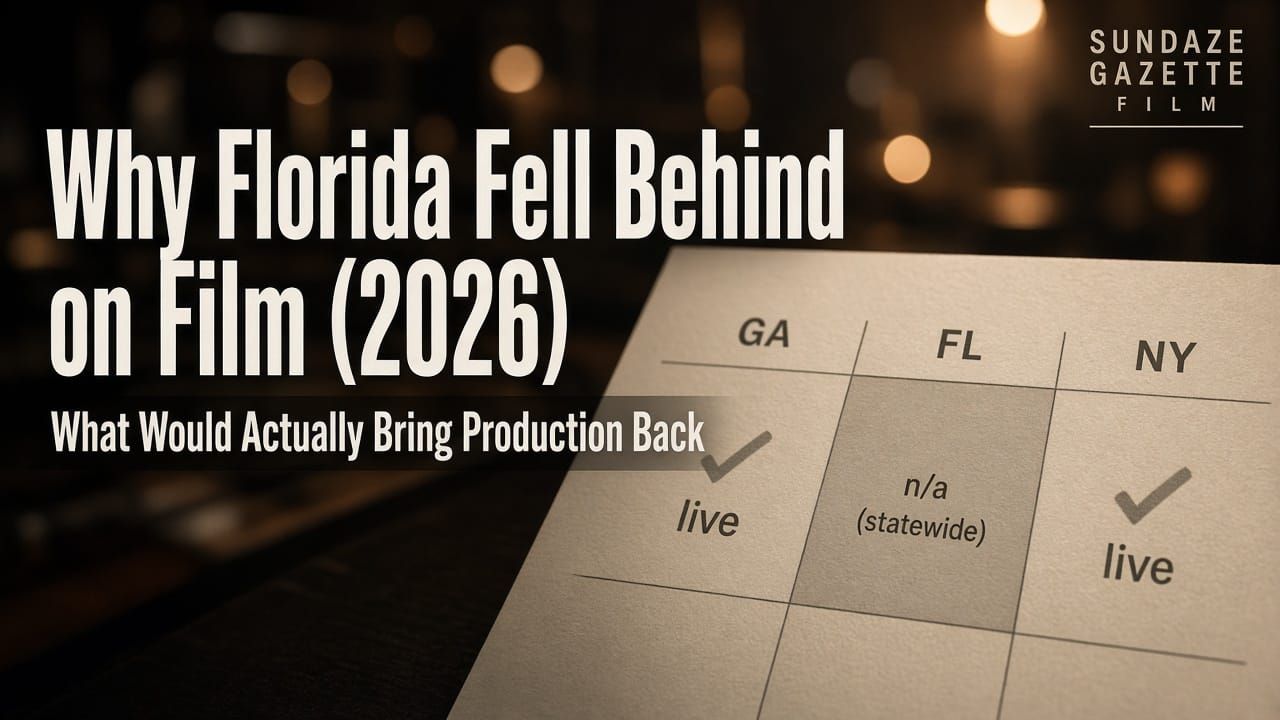
On a Monday morning in Broward, a location manager’s spreadsheet looks ordinary until you read the columns: hotel nights, grip packages, stage days, and a cell that still says “incentive — n/a (statewide).” That empty cell is not a vibe. It is how productions decide whether South Florida is a first-choice shoot or a second-unit postcard. Georgia’s program page still advertises a bankable transferable credit. New York’s Empire State Development page still posts a 30 percent production credit with a multi-year allocation. Florida’s statewide entertainment tax credit ended a decade ago — and the 2026 legislative session did not put a competitive replacement on producers’ balance sheets.
This is an owner-intelligence brief for Film + Content Economy readers along the Broward–Palm Beach–Miami corridor: what competitors publish in hard numbers, why Florida’s gap is structural rather than atmospheric, and what legislators, film offices, crews, landlords, and civic readers can do with tools that exist now — without pretending a specialty plate is a production credit.
What Georgia and New York still put on the deal memo
Line producers budget certainty. They open official program pages, not mood boards.
Georgia. The Georgia Department of Economic Development’s film incentives pages describe a 20 percent base transferable tax credit on qualified Georgia expenditures, with an additional 10 percent Georgia Entertainment Promotion (GEP) uplift for projects that meet promotional and multi-market distribution requirements — a stack that can reach 30 percent for qualifying titles. The published floor is $500,000 in annual minimum qualified expenditures (one project or combined across projects). Georgia’s program copy frames the tool as a tax credit rather than a rebate, with no annual cap and no sunset clause on the pages reviewed for this brief. The Georgia Department of Revenue’s film tax credit information page matches the same core math: at least $500,000 of qualified expenditures in a state-certified production; 20 percent of the base investment; an additional 10 percent for including a qualified Georgia promotion. Commercials, per Georgia’s incentives pages, sit on the 20 percent base and do not qualify for the 10 percent GEP uplift. Official pages: georgia.org film incentives and Georgia DOR film tax credit information.
New York. Empire State Development’s Film Tax Credit Program (Production) page states that productions which comply with requirements may be eligible for a tax credit of 30 percent of qualified production expenses — including certain above-the-line wages subject to a cap, below-the-line wages, and production costs directly related to a qualified film. The same page states the credit is funded at $700 million a year through 2036. Separate ESD tracks (including Independent Film and Production Plus enhancements) exist under their own eligibility rules; the controlling headline for competitors shopping Florida against New York remains the 30 percent / $700 million production-credit frame on the ESD program page. Official page: ESD New York State Film Tax Credit Program (Production).
Those are not press-release metaphors. They are numbers a UPM can put beside Atlanta stage rates or a Brooklyn facility day. Florida cannot currently answer with a statewide equivalent.
Why Florida fell behind — process, not personality
The statewide credit ended in 2016. Florida’s Entertainment Industry Financial Incentive Program, codified at former Fla. Stat. §288.1254, was created to attract filming and digital production and to sustain workforce and infrastructure. The statute’s repeal language took effect July 1, 2016. Contemporary Florida Office of Film and Entertainment reporting and later Economic Estimating Conference / Office of Economic and Demographic Research analysis describe the program as beginning July 1, 2010 and expiring June 30, 2016, with a total statutory authorization of $296 million in tax credits over the program’s life. Credits certified before the sunset could still be awarded under wind-down rules; the open-ended statewide certification engine itself stopped. Film Florida’s contemporaneous session wrap documented that the Legislature allowed the financial incentive program to sunset after extension efforts failed. Official anchors: 2016 Fla. Stat. §288.1254, Senate statute history, OFE annual reporting, and Film Florida’s sunset notice.
The 2026 session did not restore a statewide production tax credit. Searches of 2026 Florida Senate bill indexes for a revived entertainment-industry financial incentive / §288.1254-style production credit did not surface an enacted statewide tax-credit replacement. What *did* move in the culture-and-plates lane was different statute entirely.
A Film Legacy plate is not a bankable production credit. CS/SB 246 — Chapter 2026-30 — is a specialty-license-plate omnibus with an effective date of October 1, 2026. Its enrolled text directs the Department of Highway Safety and Motor Vehicles to develop a Florida Film Legacy plate (“Florida” at the top; “Film Legacy” at the bottom), with annual use fees distributed to Feature Florida Partnerships, Inc., a 501(c)(3), and with an annual financial-report duty beginning September 1, 2027. A standalone House vehicle, HB 1135, died in subcommittee; the companion plate language advanced through SB 246. Official cite: CS/SB 246 and enrolled chapter text. Cultural funding and marketing adjacency can matter to nonprofits. They do not replace a transferable or refundable production credit a studio finance desk can model against Georgia’s 20-plus-10 or New York’s 30 percent / $700 million frame. Say that plainly without scorning the plate’s sponsors: different instrument, different job.
County patchwork is real — and uneven. Broward’s Film Lauderdale menu is among the clearest published county toolkits in South Florida: performance-based rebates with published spend floors and caps, plus a creator-scale Emerging Filmmakers Grant. Other counties run permits, location services, and smaller or differently structured programs. A seven-county scavenger hunt can win a commercial. It rarely beats a statewide credit on a series bible. For published Broward structure, use Film Lauderdale’s live incentives page and the Gazette’s Broward County film incentives / Film Lauderdale map — verify rates and caps there before you quote them into a bid.
Sales-tax exemption is still a tool, not a labor credit. Qualified production companies can still pursue Florida’s entertainment industry sales-and-use tax exemption on qualifying production equipment under §288.1258 and the Department of Revenue’s Film in Florida certificate path (90-day and 12-month certificate categories as DOR publishes). The Gazette’s owner how-to is live: Florida entertainment industry sales-tax exemption. Useful. Stackable with county rebates where both fit. Not a substitute for a statewide labor-and-spend credit.
What the gap costs South Florida operators
Weather, airports, multilingual crews, and lifestyle still sell. What does not sell is pretending an empty statewide cell equals Georgia’s transferable credit. When a Midwestern series or a coastal indie compares states, the competitor packages above are already on the table. South Florida then competes on logistics, relationships, and local incentives — which is why documenting Broward spend, keeping vendor lists audit-ready, and treating stages as commercial real estate rather than hobbyist culture is the honest near-term play.
The federal conversation — a possible national labor-tied production credit still in draft form as trade desks have reported it — does not close Florida’s state-to-state gap by itself. Gazette twins already map that stacking problem: Federal Floor, Florida Gap and why a national floor still leaves SoFla owners working local tools. A federal floor, if enacted, would sit beside state programs elsewhere; Florida would still need county patches plus any federal eligibility unless Tallahassee restores a statewide instrument. Do not invent passage or percentages beyond what those live briefs lock.
Infrastructure without volume thins. Stage owners, grip houses, costume shops, and location scouts stay solvent on bookings. Bookings follow certainty. Certainty follows published, bankable incentives — or, in Florida’s case today, a disciplined stack of county rebates, sales-tax certificates, and local grants.
What would actually bring production back
1) Ask legislators for a competitive statewide production incentive — specifically. “Support the arts” is not a bill number. Owners, crew, vendors, and civic readers who want film volume should ask House and Senate members for a statewide production tax credit or rebate with published rates, floors, audit rules, and a multi-year horizon line producers can model — and they should ask how any proposal compares to Georgia’s transferable 20-plus-10 and New York’s 30 percent / $700 million allocation. Bring hotel-night, vendor-spend, and payroll evidence from shoots that already happened under county tools. Policy debate without promising a restoration date: Florida film incentive discussions — details matter.
2) Back Film Florida and local film offices with data, not only posts. Membership, hearing testimony, and clean expenditure reports move committee rooms more than a thread. Film Florida’s industry association lane and county film commissions are the standing desks that translate shoot math into legislative packets. Document what county rebates already returned — Broward spend, crew days, lodging — so the next session fight starts with receipts.
3) Use what is live now.
- County rebates where you qualify — start with Film Lauderdale’s incentive programs and the Gazette’s Broward map linked above.
- Sales-tax exemption for qualifying equipment via DOR / §288.1258.
- Film Lauderdale Emerging Filmmakers Grant — applications may be submitted starting October 1, 2026; published award $10,000 with required $10,000 match and Broward-resident criteria. Soft-link the Gazette reopen brief: Film Lauderdale Emerging Filmmakers Grant Oct. 1 reopen. That grant does not replace a statewide credit; it is a real local door with a calendar date.
- Stage and campus adjacency — the Fort Lauderdale studio chapter remains an infrastructure story buyers can tour; see the Gazette’s Buffalo FilmWorks / Fort Lauderdale studio coverage.
4) Treat CRE and stages as economic development inventory. Landlords and owners who can deliver sound isolation, power, parking, wrap space, and production-friendly lease language are competing for tenants who write checks in weeks, not years. Crew housing, vendor bays, and post suites belong on the same asset map as hospitality. Entertainment infrastructure is not only a cultural amenity; it is square footage with a utilization rate.
5) Keep federal and state clocks separate. Track any national production-incentive drafting as a separate layer from Tallahassee. Soft-link the Gazette’s federal twins for owners who need stack models — including the MPA study / coalition SoFla stages brief — and do not paste unenacted federal percentages onto a Florida rate card.
Practical checklist — owners, crews, landlords, civic readers
Owners / producers
- Build two bid models: (A) county rebate + sales-tax exemption + logistics; (B) sales-tax exemption + logistics only when no rebate fits. Leave a third column blank for any future statewide credit — do not invent the rate.
- Pull Film Lauderdale eligibility conversations and DOR certificate timing before promising investors a Florida stack that matches Georgia.
- If you are Broward-resident and creator-scale, assemble the Emerging Filmmakers match packet against the Oct. 1, 2026 submit window.
- Keep vendor and crew residency documentation audit-ready; county programs live and die on paperwork clocks.
Crews / vendors
- Stay on local film-office and Film Florida contact lists; volume follows relationships when the statewide cell is empty.
- Price and invoice so Qualifying Payroll / Qualifying Expenditures lines are clean for county audits.
- Treat festival and brand-work calendars as cash-flow bridges, not substitutes for incentive policy.
Landlords / CRE
- Inventory buildings that can become stages, mill space, or production offices; price power, HVAC, and parking as production specs.
- Ask counsel about production-friendly use language and insurance before the scout arrives.
- Track campus and studio announcements as tenant-demand signals, not only as culture news.
Civic readers / advocates
- Email or call your state representative and senator with a specific ask: restore a competitive statewide production incentive with published terms comparable to peer states.
- Attach one page of local spend evidence (hotel nights, vendor invoices totals, crew days) from a recent county-incentivized shoot if you have it.
- Distinguish plate-and-foundation funding from production credits in every hearing comment — support both if you wish, but do not conflate them.
- Show up for Film Florida / county film office advocacy windows with numbers, not only slogans.
Florida still has the light, the locations, the airports, and a corridor of owners who already know how to run a set. What it has not had since 2016 is a statewide credit peers can still print on a deal memo — and the 2026 session’s Film Legacy plate, while real as specialty-plate law, does not fill that cell. Bring production back with a bankable statewide instrument, disciplined use of county and sales-tax tools that already exist, and CRE strategy that treats stages like the economic assets they are.
Key Facts for Owners and Search
Verified competitor rates (program pages, 2026 check)
- Georgia: 20% base transferable credit + 10% GEP uplift (up to 30% for qualifying projects); $500,000 annual minimum; no annual cap / no sunset per Georgia incentives program copy. Sources: georgia.org/industries/film/incentives; dor.georgia.gov/film-tax-credit-information.
- New York: 30% of qualified production expenses; funded at $700 million/year through 2036. Source: ESD Film Tax Credit Program (Production).
Florida statewide credit
- Entertainment Industry Financial Incentive Program (§288.1254) repealed July 1, 2016 / expired June 30, 2016; historical authorization $296 million.
- Not restored as a statewide production tax credit in the 2026 session (no enacted §288.1254-style replacement identified in session bill review for this brief).
2026 Film Legacy plate (not a production credit)
- CS/SB 246, Chapter 2026-30; effective Oct. 1, 2026; Florida Film Legacy specialty plate; annual use fees to Feature Florida Partnerships, Inc. Source: flsenate.gov/Session/Bill/2026/246.
Use-now Florida tools
- County rebates (Broward / Film Lauderdale published menu): filmlauderdale.org incentives · Gazette map: broward-county-film-incentives-2026-film-lauderdale
- Sales-tax exemption §288.1258 / DOR Film in Florida: floridarevenue.com Film in Florida · Gazette how-to: florida-entertainment-industry-sales-tax-exemption-apply
- Emerging Filmmakers Grant: applications may be submitted starting Oct. 1, 2026; $10,000 award / $10,000 match (Film Lauderdale published criteria) · Gazette: film-lauderdale-emerging-filmmakers-grant-oct-1-2026-reopen
Related Gazette film incentive twins (HTTP 200)
- Federal Floor, Florida Gap
- National film floor — SoFla owner benefit now
- MPA study / coalition / SoFla stages
- Fort Lauderdale studio / Buffalo FilmWorks
- Film Florida Week West Palm owners
- Florida film incentive discussions — details matter
Owner search strings
- Florida film tax credit expired 2016
- Georgia film tax credit 20% 10% uplift
- New York film tax credit 30% $700 million
- Florida Film Legacy license plate SB 246
- Film Lauderdale Emerging Filmmakers Grant October 1 2026
- Florida entertainment sales tax exemption 288.1258
- bring film production back to Florida statewide incentive