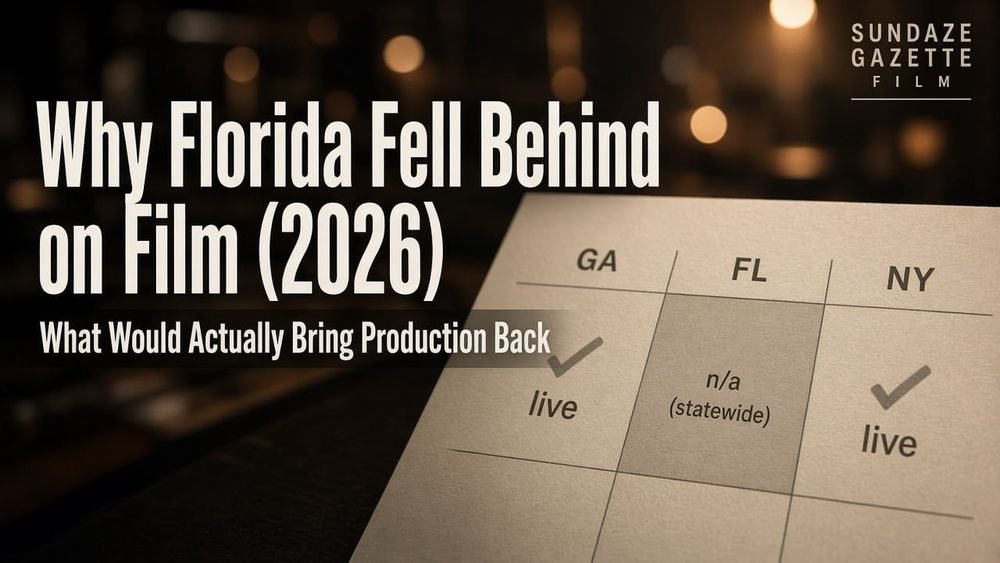
Florida lacks a broad statewide film-production tax-credit program, but Fort Lauderdale has developed a dynamic production ecosystem full of incentives and support. Broward County provides substantial cash rebates while Florida offers a production sales-tax exemption, with Film Lauderdale generally waiving film-permit fees.
Understanding the Financial Landscape
The distinction is clear between the absence of a statewide tax credit and the local incentives available:
- No statewide production tax credit
- Existing Broward County cash rebates
- Florida’s sales-tax exemption
- Project-specific grants, sponsorships, and appropriations
- Private independent financing
The producers behind the series A Land Remembered illustrate this financial landscape. Contrary to claims that they operated without incentives, their financing strategy included independent ownership, a $500,000 legislative appropriation from Florida, and a matching amount from Visit Tampa Bay, alongside private investors covering most production costs. They filmed two episodes over approximately 40 days in March, April, and May 2026, with plans for two more episodes before pursuing broader distribution.
While it’s accurate to state A Land Remembered is produced without Florida’s former statewide tax-credit program, it heavily relies on public funding, tourism support, private investment, and community cooperation. This model is difficult to replicate, given the cultural significance of the underlying novel and the recognition it received from lawmakers.
Broward County's Competitive Incentives
Broward County boasts the largest local screen-production incentive fund in Florida. Unlike state tax credits, these incentives take the form of rebates, which are paid after qualifying production expenses and local hiring have been verified. The current structure for Broward County incentives is as follows:
| Production Category | Minimum Spend | Incentive |
|---|---|---|
| Film & Television Program | $400,000 | 20% rebate, capped at $800,000 |
| High Impact Film & TV | $5 million | 20% rebate, capped at $2 million |
| Scripted Series | $12 million | 25% rebate, capped at $5 million |
| Multiple Project Guarantee | $4 million per project; two projects | 30% rebate, capped at $2.5 million per project |
| Partial Project | $1.5 million | 20% rebate, capped at $500,000 |
| TV Commercial Attraction | $400,000 | 15% rebate, capped at $175,000 |
| Emerging Filmmakers Grant | Minimum $20,000 total budget | $10,000 grant; paused for summer 2026 |
Clarifying Misconceptions
An important correction to previous reports clarifies that Broward County’s maximum rebate rates belong to separate programs. Florida Trend inaccurately summarized the incentives, conflating the 30% cap for the Multiple Project Guarantee with the $5 million cap for the Scripted Series program. The actual rebate structure provides different incentives based on categorical spend.
For producers seeking these rebates, specific requirements govern qualification, such as:
- Spending a minimum of $400,000 in Broward County.
- Filming at least 60% of production days in Broward.
- Hiring at least 55% of the main cast and crew from Broward, Miami-Dade, or Palm Beach, with at least 30% from Broward.
- Using Broward businesses for at least 50% of vendors.
- Employing two qualifying local college students or recent graduates.
Each application is reviewed individually, with funding determined by availability. Productions must also maintain detailed records to ensure rebate eligibility.
Challenges of Performance-Based Financing
Broward's incentives function as performance-based rebates. As such, producers do not receive direct funding for initial shooting costs. Producers must secure sufficient capital to cover production expenses, payroll, and local vendor payments while awaiting reimbursement post-production.
Florida's Other Production Benefits
Florida offers an Entertainment Industry Sales Tax Exemption, enabling qualified productions to save up to 7.5% on eligible purchases and rentals, including essential production materials. However, this exemption does not cover all budgetary needs, with lodging and other costs designated as non-qualified.
Production Logistics in Fort Lauderdale
Film Lauderdale oversees the permitting process for Broward County, typically requiring a minimum of three business days. More complex filming scenarios require longer lead times. Notably, Broward generally charges no film-permit fee but still requires payment for specific service recoveries.
Broward also possesses a robust production infrastructure. Film Lauderdale’s directory includes various production stages, motion-capture facilities, and post-production resources, making it an attractive destination for filmmakers.
Maximizing Financial Opportunities
Producers should consider a multifaceted financing strategy rather than relying on a single source. Successful funding models incorporate:
- Private production equity
- Broward County rebates as post-production reimbursement
- Florida sales-tax exemption
- Distribution financing such as minimum guarantees
- Tourism and marketing opportunities
- Brand integration and local sponsorship
- In-kind partnerships with property owners
- Project-specific public funding, when applicable
Navigating Local Challenges
Filmmakers in Fort Lauderdale should be aware of specific challenges, including local wildlife regulations, drone guidelines, and weather conditions that can impact production schedules. Compliance with local hiring standards is crucial to maintaining incentive eligibility.
A Path Forward for Fort Lauderdale Productions
Producing films and television projects in Fort Lauderdale without a statewide tax credit is feasible. Broward County’s local incentives, sales-tax benefits, streamlined permitting, and established infrastructure create a supportive environment. While not without challenges, the local production model enables filmmakers to build competitive financing strategies for independent films, television series, and commercials.