Two Districts, One Question
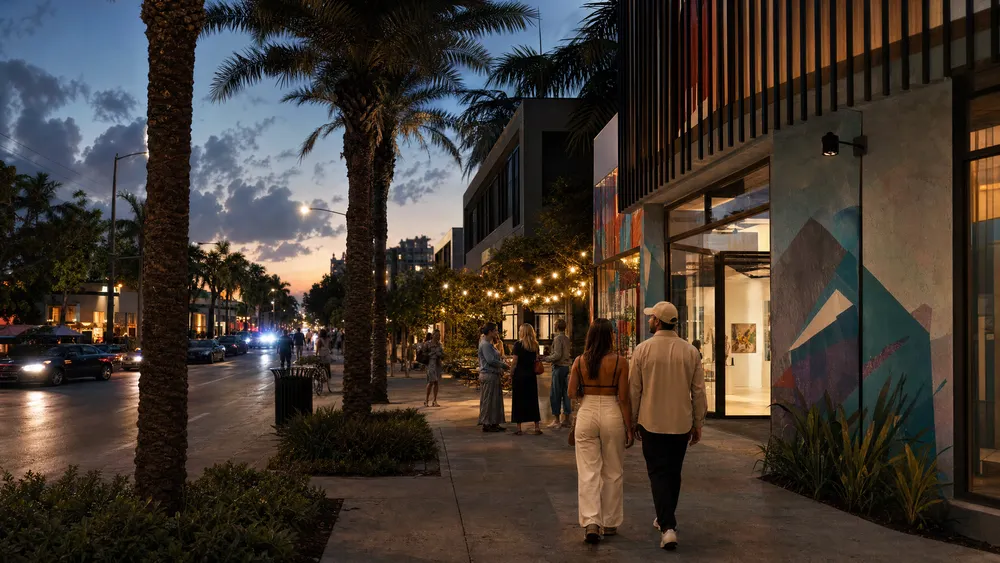
The creative district sells a familiar promise: studios, offices, restaurants, public art and homes within a few walkable blocks. In South Florida two projects are testing that promise at scale, Fort Lauderdale’s FAT Village and West Palm Beach’s Nora District. Both start from old industrial buildings, both lean on the culture that grew there first, and both are now leasing space to the businesses that will decide what the neighborhoods feel like day to day.
For an owner weighing a lease, a creator looking for a studio or a restaurateur scouting a second location, the useful questions are concrete. What is being built, who is building it, what is open now, and what will the street look like when the cranes leave? The developers’ own pages answer more of that than many people realize.
FAT Village: From Warehouses to a Mixed-Use Block
FAT Village’s development site calls the area Fort Lauderdale’s arts and culture hub for 20 years and describes its next phase as an urban village with homes, mass timber offices, dining and retail. It lists a 725,300-square-foot mixed-use district with 600 residential units, 77,000 square feet of restaurants, retail and entertainment, and 180,000 square feet of Class AA office space, centered at North Andrews Avenue and NW 1st Street. The office building, T3 FAT Village, is a 176,000-square-foot mass timber workspace with large floor plates and private balconies.
The project is led by Hines with Urban Street Development, the Fort Lauderdale firm run by Alan Hooper and Tim Petrillo. SCB, the master plan architect, describes a 5.5-acre redevelopment with 850 residential units across two buildings, including affordable artist studios, along with reused materials from the original warehouses, galleries, murals, pedestrian paseos in former alleys and support for traditions such as the Art Walk. The developer site and the architect’s page give different unit counts, so treat the totals as plans and ask the leasing team for the current figures.
Nora: A Railroad Corridor Reworked
Nora takes its name from North Railroad Avenue. Its developers describe a 40-acre transformation of the corridor that restores 1920s-era warehouses alongside new buildings, with dining, wellness, retail, offices, homes, a hotel and green plazas. The project is led by NDT Development, Place Projects and Wheelock Street Capital in partnership with the City of West Palm Beach, and the district says it is positioned to anchor the northern expansion of downtown.
The tenant mix is already taking shape. The district’s site lists The Nora Hotel, Gro Yoga and Wellness, the jeweler LUCE and Loco Taqueria and Oyster Bar, and says the New York brasserie Pastis is arriving soon. The district’s address is 845 N. Railroad Ave., and its leasing page lists units available for immediate lease through CBRE.
What It Means for Owners and Creators
Districts like these are designed to reward businesses that bring people to the street. Restaurants, studios, galleries, fitness and wellness concepts and makers with a retail counter tend to fit the plans the developers describe, because those uses fill sidewalks in the daytime and the evening. Office tenants get proximity to that energy, which is part of what the T3 pitch and Nora’s office space are selling.
The trade-off is cost and timing. Space in new or restored buildings can cost more than older industrial space nearby, and a district that is still under construction can mean less foot traffic in year one than the renderings suggest. A small business that signs early may get a better location and terms, but it should plan its cash for a slower opening stretch.
Questions to Ask Before You Sign
Start with the basics the brochures do not print: rent per square foot, common area charges, the build-out allowance, the lease length and any percentage-rent clause. Ask which neighbors are signed and which are still prospects, when nearby buildings will finish, and how parking and loading work for customers and deliveries.
Ask how the district plans to program its public spaces and whether tenants can use them for events, pop-ups or shoots. For creative tenants, ask about sound, ceiling height, power and after-hours access, since a studio’s needs differ from a boutique’s. And ask whether any space is set aside for artists or local businesses at different price points, because that answer says a lot about who the district expects to serve in five years.
Updated Oct. 9, 2026: project figures, partners and tenants rechecked against the FAT Village, SCB and Nora District pages.
Sources
- FAT Village, development home page
- FAT Village, About (Hines and Urban Street Development)
- FAT Village, T3 office
- SCB, FAT Village master plan
- Nora District, home page
- Nora District, history and development team
- Nora District, Leasing
Related reading: South Florida Third-Place Economy: Where Owners Build; What Broward Development Pressure Means for Local Owners.
Key Facts for Owners and Search
What is planned at FAT Village in Fort Lauderdale?
The FAT Village development site lists a 725,300-square-foot mixed-use district with 600 homes, 77,000 square feet of restaurants, retail and entertainment, and 180,000 square feet of Class AA office space, including the 176,000-square-foot T3 mass timber building. Hines leads the project with Urban Street Development. Architect SCB’s page cites 850 residential units, so confirm current figures.
What is the Nora District in West Palm Beach?
Nora, short for North Railroad Avenue, is described by its developers as a 40-acre transformation of a historic industrial corridor, mixing restored 1920s-era warehouses with new buildings for dining, wellness, retail, offices, homes and a hotel. NDT Development, Place Projects and Wheelock Street Capital lead it in partnership with the City of West Palm Beach.
Which businesses fit a creative district?
Uses that bring people to the street day and night fit best: restaurants, studios, galleries, fitness and wellness concepts, and makers with a retail counter. Office tenants benefit from that activity nearby. Early tenants may win better locations and terms but should budget for slower foot traffic while surrounding buildings are still under construction.
Do these districts publish rents?
No. Neither FAT Village nor Nora posts rents on its public pages. Both list leasing contacts through their websites, and Nora’s leasing page shows units available for immediate lease through CBRE. Ask for rent per square foot, common area charges, build-out allowances, lease length and any percentage-rent terms in writing before comparing locations.
What should creatives ask before leasing in a mixed-use district?
Ask about sound, ceiling height, power, loading and after-hours access, and whether tenants can use plazas or streets for events, pop-ups or shoots. Ask which neighbors are signed, when nearby buildings finish, and whether any space is set aside for artists or local businesses at lower price points, since that shapes the district’s future.