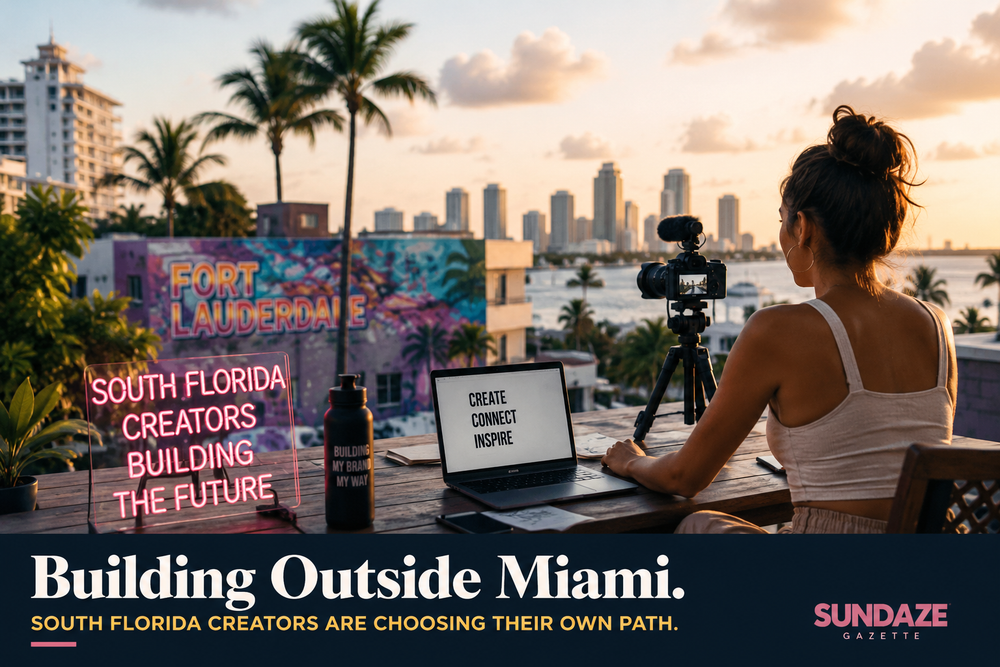
Broward's creator economy is easier to see when you stop looking for a single migration story.
The public record does not prove that creators are leaving Miami in a wave, or that any individual artist or filmmaker chose Broward for one specific reason. What it does show is more practical: Broward has built a visible stack of arts and production infrastructure around grants, public art, cultural festivals, film permitting, location databases, workforce training, and private arts funding.
For creators working in film, video, visual art, events, design, publishing, music, and branded storytelling, that infrastructure matters. It can make a place easier to work in, easier to navigate, and easier to explain to collaborators, clients, funders, and audiences.
The Brief
- Broward County's FY2025 annual report says the Cultural Division provided $7.2 million in grants to 116 arts organizations and another $400,000 to 74 artists.
- The county says Film Lauderdale brought $207.3 million in local economic impact and 16,212 jobs for cast and crew in FY2025.
- Film Lauderdale's FY2025 work included one-stop permitting across 27 municipalities and county departments, a larger production directory, 121 new location database entries, and eight Emerging Filmmakers Grant grantees.
- Broward's Arts & Economic Prosperity 6 page says nonprofit arts and culture generated $386 million in total industry expenditures in FY2022.
- Fort Lauderdale's public art program allocates 2% of the Community Investment Program budget to public art initiatives.
The infrastructure is bigger than venues
Arts infrastructure is not only a theater, a museum, or a festival weekend. For the working creator, it includes the less glamorous systems underneath the public-facing scene: grant cycles, public art programs, location databases, production directories, permitting offices, training programs, and civic organizations that keep creative work visible.
Broward County Cultural Division describes its role in those terms. The division says it invests in and promotes the arts and culture sector and the creative community, offers grants to cultural organizations and artists, manages the County's Public Art & Design Program, and advances the creative sector through community engagement, special events, and capacity-building.
The county's FY2025 annual report puts numbers around part of that system. It says the Cultural Division provided $7.2 million in grants to 116 arts organizations, plus another $400,000 awarded to 74 artists. It also says Broward launched a $1 million Arts and Cultural Festival sponsorship program to support municipal, community, and neighborhood arts and cultural festivals.
That does not tell the story of every creator in the county. It does show a public funding structure that treats arts and culture as part of the county's civic and economic life, not just weekend entertainment.
Film Lauderdale turns production into a countywide system
Film and video production are where Broward's creator-economy infrastructure becomes especially concrete.
Broward County's FY2025 annual report says Film Lauderdale brought $207.3 million in local economic impact and 16,212 jobs for cast and crew, with production expenditures up 15% and total hires up 41% from FY2024. The same report says Film Lauderdale expanded Film & TV Incentive Programs and, to date, contracted with 47 projects with combined budgets over $24.3 million.
For smaller creators and production businesses, the logistics may matter as much as the headline numbers. The county says Film Lauderdale launched FilmApp/Apply4, a film permit platform for one-stop permitting across 27 municipalities and county departments, and finalized formal interlocal agreements with 25 municipalities to date.
The report also says Film Lauderdale increased its Production Directory by 25%, added 121 new locations to the Film Commission's Location Database, and approved eight new grantees through the Emerging Filmmakers Grant program, which the county describes as funding resources for resident content creators producing individual projects.
Those are infrastructure signals. A creator trying to shoot a short film, commercial, music video, web series, documentary, or branded project needs more than a camera. They need locations, rules, crews, permits, and local contacts. Broward is making more of that machinery visible.
Public art and festivals make creative work visible
The arts side of Broward's infrastructure is also increasingly public-facing.
The county's FY2025 annual report says IGNITE Broward featured more than 25 art installations in Hollywood, Dania Beach, and Fort Lauderdale, with more than 80,000 people attending. It also says Arts Launch Broward featured more than 70 Broward artists and arts organizations at the Broward Center for the Performing Arts, drawing more than 1,600 community members.
Public art is another piece of the map. Fort Lauderdale's Public Art and Placemaking Program was established in 2020 and allocates 2% of the Community Investment Program budget to public art initiatives throughout the city. The city says the program contributes to aesthetic enhancement while creating a cultural environment that reflects the city's vision, diversity, and character.
For creators, these programs do not guarantee work. But they do create more visible surfaces for creative labor: murals, installations, festivals, calls to artists, public spaces, and civic projects where art is part of how a city presents itself.
Why it matters
South Florida's creative economy is often discussed through Miami. Broward's official record shows a broader regional system: arts grants, film permitting, public art, festivals, production support, and private arts funding that give creators more places to work and more institutions to navigate.
What to watch
The next reporting question is whether individual creators, venues, studios, and small creative businesses are turning this infrastructure into repeat local work. That will require interviews, project examples, and creator-level data.
The economic case is already part of the pitch
Broward's arts argument is not only cultural. It is economic.
Broward County's Arts & Economic Prosperity 6 page says nonprofit arts and culture generated $386 million in total industry expenditures in FY2022. The same page lists $247 million in event-related expenditures and $267 million in personal income paid to residents.
Greater Fort Lauderdale Alliance frames the creative economy broadly, describing a sector that includes museums and collections, performing arts, visual arts and photography, film, radio and TV, design and publishing, and arts schools and services. The Alliance says these businesses employ people, purchase local goods and services, generate government revenue, and serve as a cornerstone of tourism.
That definition is useful because the modern creator economy is rarely one lane. A creator may shoot video, design campaigns, license photography, perform live, host events, run a newsletter, sell merchandise, or collaborate with a venue. The more local systems support multiple parts of that stack, the easier it becomes for creative work to behave like a business.
Private arts funding rounds out the map
Public agencies are not the only support system.
Funding Arts Broward describes itself as one of the few dedicated funders of the arts in Broward County. The organization says it has awarded more than $6 million in grants to Broward's arts community since 2003, and lists a $735,000 annual impact tied to its 2026 grant pool, Arts Access Grant, and FAB Goes Public.
That matters because creator economies are usually built through overlapping institutions, not one program. County grantmaking, city public art, private arts philanthropy, production incentives, and economic-development organizations all shape the environment around creative work.
What the public record does not prove
The strongest version of this story is also the narrowest one.
The sources reviewed here do not prove that creators are leaving Miami at scale. They do not prove that individual artists are choosing Broward because of grants, cost, venues, or lifestyle. They do not prove that every program is easy for a working creator to access.
What they do prove is that Broward has a documented arts and production infrastructure: money moving through grant programs, public art built into civic budgets, film permitting systems, production directories, location databases, training programs, festivals, and private arts support.
That is enough to change the regional question. Instead of asking whether Broward is replacing Miami, the better question is how much creative work can grow when more of the region's infrastructure is visible outside Miami's core.
Sources used
- Broward County Cultural Division - County overview of arts grants, public art, creative-sector programming, events, and capacity-building.
- Broward County FY2025 Annual Report: Arts, Recreation & Learning - Cultural Division grants, festivals, public art, IGNITE Broward, Arts Launch Broward, and Film Lauderdale location-support facts.
- Broward County FY2025 Annual Report: Economic Prosperity - Film Lauderdale economic impact, jobs, permits, production directory, location database, workforce training, and emerging filmmaker grant details.
- Broward County Arts & Economic Prosperity 6 - Nonprofit arts and culture economic-impact figures for Broward County.
- Greater Fort Lauderdale Alliance: Creative Economy - Regional creative-economy categories and economic-development framing.
- Film Lauderdale Screen Industry Incentive Programs - Program definitions, production categories, qualifying payroll, and application-process context.
- City of Fort Lauderdale Public Art Program - Public Art and Placemaking Program overview and public-art funding structure.
- Funding Arts Broward - Private arts funding, grant totals, and annual-impact context.
Disclosure: This article was drafted with AI assistance by The Sundaze Gazette editorial team and reviewed before publication.