On July 1, 2026, Florida flipped a switch that South Florida multi-asset owners had been waiting on for years. CS/SB 316 — signed into Chapter 2025-162, Laws of Florida — added the Uniform Protected Series Provisions to the Florida Revised Limited Liability Company Act. The short title sits at §605.2101; the effective-date rule is §605.2802. Beginning that day, Chapter 605 governs domestic and foreign protected series LLCs and series that transact business in Florida. The Department of State opened online designations at seriesllc.sunbiz.org the same morning.
As of mid-September 2026, the law has been live for roughly eleven weeks. Social clips that treated July 1 as a same-day “FOREVER” rewrite of LLC law were timing-accurate about go-live and oversold about what the filing actually buys. This Gazette Owner Map is for Palm Beach, Broward, and Miami-Dade operators who stack rentals, brands, production vehicles, franchise units, or holding-company sleeves — and need the statute and Sunbiz mechanics, not a reel paraphrase. It is not legal, tax, or insurance advice. Talk to Florida business counsel, a CPA, and your broker before you retitle anything that matters.
What Changed on July 1 — and What Did Not
Florida did not invent a brand-new blank “Series LLC” entity you file from a cold start. Per the DOS Series LLC FAQ, you cannot file a standalone Florida Series LLC. An existing active Florida LLC becomes a series limited liability company when it designates its first protected series with the Department of State. A protected series is a legally distinct portion of that LLC — not a separate Sunbiz entity. It does not get its own record or document number, and it does not get its own Sunbiz entity page. If the mothership dissolves, the series dissolve with it.
That architecture is the first place marketing slides and real paperwork diverge. Owners who expect a second company page on search.sunbiz.org will be confused. What you get instead is a designation tied to the parent’s document number, a mandatory naming convention, and — if you do the books right — a horizontal liability wall between series and between a series and the mothership, on top of the classic vertical wall that already kept members off the hook for ordinary LLC debts (subject to veil-piercing and other limits).
Naming is public and rigid under §605.2202. The series name must begin with the mothership’s name and include “protected series,” “P.S.,” or “PS.” The online form auto-prefixes the parent name and a dash; you type the second half. No sneaking in “Inc.” or partnership-style identifiers. Certificates of status for a specific series are available for $5 — often what lenders and insurers ask for — while the mothership still files the annual report that lists active designated series.
Vertical Shield, Horizontal Shield — One Plain Example
Think of a Broward landlord with three single-family rentals inside one Florida LLC. Before July 1, a tenant injury or vendor claim against Property A could, as a practical matter, put pressure on everything titled in that same LLC. Separate LLCs per property were the traditional answer — and still are, for many financed deals.
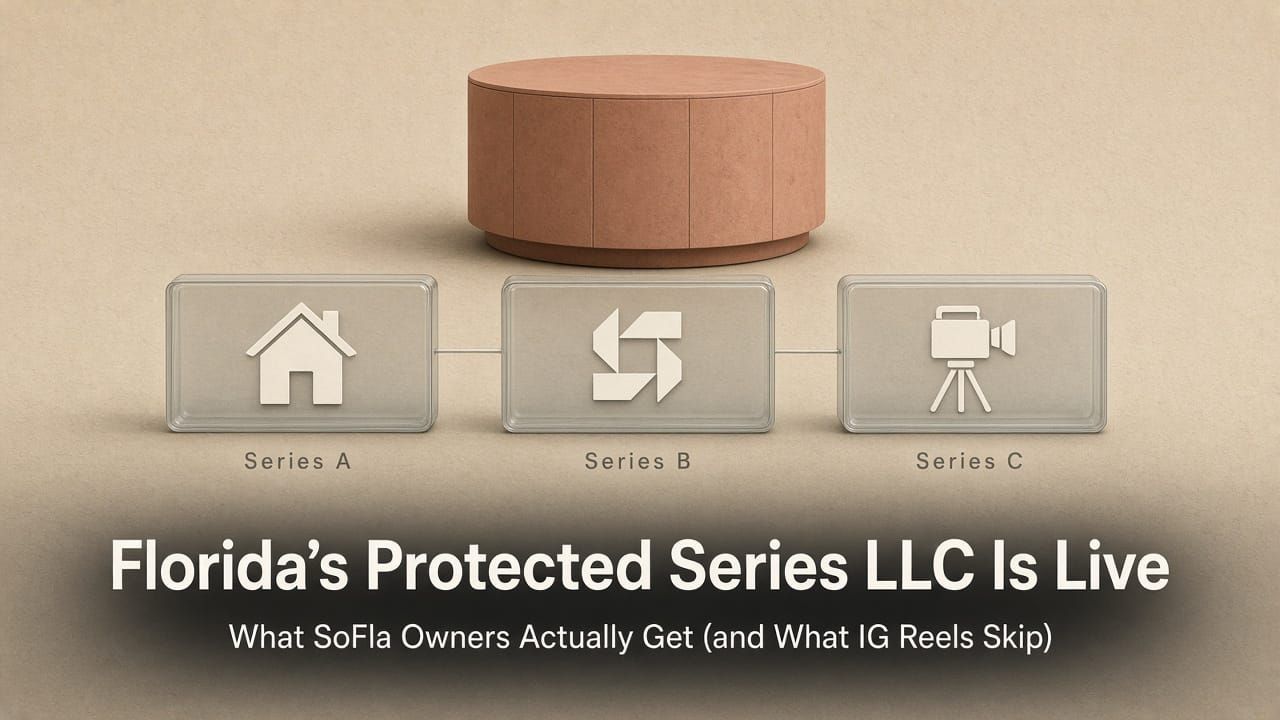
Under the protected-series statute, the same mothership can designate, for example, Acme Holdings LLC - Protected Series A, … Series B, and … Series C. §605.2401 is the liability engine: debts of one protected series are, as a baseline rule, solely that series’ debts; the mothership and sibling series are not liable solely by reason of the series structure. Members and associated managers get the classic non-liability language as well. That is the horizontal / internal shield stacked on the vertical shield owners already know.
The catch is not the $25 filing. It is §605.2301. An asset is an “associated asset” of a series only if contemporaneous records name the series and describe the asset with enough specificity that a disinterested, reasonable individual can identify it, distinguish it, and trace how it was acquired. Florida also treats certain recorded real-property deeds as association records — a non-uniform tweak that helps title practice when deeds are done correctly. Hold Series A’s deed, bank account, or lease in the mothership’s name (or Series B’s name), and you have not associated the asset. The horizontal wall you paid for can fail when a creditor or court looks at the books.
§605.2402 then frames disregard claims as if each series were a separately formed LLC. Failure to observe formalities is not, by itself, enough to pierce the owner non-liability in §605.2401(1) — but it may be a ground to disregard the horizontal limits in §605.2401(2). Recordkeeping is the fuse.
What Marketing Clip Says vs What the Statute Actually Delivers
Short-form explainers compress three true-ish ideas into one absolute. Owners should keep the contrast table in their head before they file.
| Clip / marketing compression | Florida law / DOS reality |
|---|---|
| “Unlimited protected cells under one company” | Statute does not set a numeric cap; DOS lets you designate multiple series in one filing at $25 each. “Unlimited” is marketing shorthand — not a promise of infinite bulletproof vaults. Practical limits are OA drafting, banks, insurance, lenders, and books. |
| “One lawsuit can’t touch the rest” | Only if the horizontal shield and associated-asset records hold — and you survive veil-piercing, bankruptcy-court questions, and suits in states that do not recognize series. Filing alone ≠ isolation. |
| Implies each series is its own company | DOS: legally distinct portion, not a separate entity; no own document number or Sunbiz page. |
| Implies set-and-forget asset protection | Statute + Florida Bar commentary: strict association records. Sloppy books expose non-associated assets. |
| July 1 “goes into effect today” framing | Accurate as of July 1, 2026 under §605.2802. By late September 2026, treat it as a live filing environment — not breaking same-day news. |
Florida Bar Journal explainers by Conti and Teblum (Parts I, II, III) are useful secondary reads for counsel; primaries for owners remain the statute and DOS.
How to Designate Today — Sunbiz Path and Fee Box
Path for most SoFla owners (existing active Florida LLC):
- Confirm the LLC is active on search.sunbiz.org; note the document/record number.
- Get unanimous member consent to establish protected series (§605.2201).
- Adopt or amend a written operating agreement that actually describes series architecture — capital accounts, managers, association rules, dissolution, charging-order language. Oral OA may be theoretically available for ordinary LLCs; for a protected-series stack it is malpractice-adjacent in practice.
- Confirm the registered agent covers mothership and all series (same RA by statute).
- File the Protected Series Designation online only at seriesllc.sunbiz.org — $25 per protected series; multiple series OK in one filing.
- Optional: series certificate of status $5.
- After filing: open separate bank accounts; retitle and associate assets under §605.2301; rewrite contracts, deeds, invoices, and insurance into the full compliant series name; set books before you claim isolation.
DOS says online designation, change, dissolution, and cancellation filings typically auto-file within one to two hours.
Brand-new LLC path: File Articles of Organization first ($100 filing + $25 registered-agent designation = $125 required; optional certified copy and status can push the total toward $160 per the DOS fees page). Wait for acceptance. Then designate series. Never file a designation before articles are accepted on the electronic path.
Annual report: The mothership still files one annual report listing active designated series. Individual protected series do not file separate ARs. Published LLC annual report with supplemental fee: $138.75; after May 1: $538.75. Miss listing a series and you can block that series’ certificate of status even though existence is not destroyed.
State fees are the cheap part. Counsel, operating-agreement work, accounting systems, retitling, and insurance schedules will dwarf the Sunbiz line items. Say that out loud in the partner meeting.
Books, Contracts, Insurance, Licensing — Where Owners Get Clipped
Contracts and title. Signature blocks, deeds, leases, invoices, and bank accounts must use the full series name. An associated asset held in the wrong name fails §605.2301 association and is a classic path into §605.2402 disregard fights.
Insurance. Policies and certificates must identify the correct legal name of the contracting series. Master policies need schedules naming each series. A claim against the wrong named insured is how “horizontal shield” becomes a coverage fight.
Charging orders. Member-creditor remedies still run through §605.0503. Multi-member settings generally keep charging order as the exclusive remedy; single-member LLCs face foreclosure risk if distributions will not satisfy a judgment in a reasonable time. Mirror charging-order language for associated-member interests at the series level; exclusive-remedy comfort is strongest with more than one associated member — a counsel draft point, not a social-clip slogan.
Bankruptcy. Florida commentary flags unresolved federal questions: whether bankruptcy courts honor both shields, whether one series can file alone, whether one filing pulls mothership and siblings in. Series structure is not a substitute for insurance, reserves, or solvent operations.
Out-of-state recognition. Operating a Florida protected series in a state that does not authorize series LLCs risks a court disregarding horizontal isolation. Miami–Broward–Palm Beach owners with New York, New Jersey, Georgia, or North Carolina ops, vendors, or properties need counsel before parking assets that will be sued elsewhere.
Professional licensing. A protected series is a UCC “person” but not a separate DOS entity with its own document number. Boards, banks, and platforms often want the mothership document number. Confirm with the relevant board before putting a licensed practice inside a series. Do not assume a series auto-inherits a mothership license.
Exit and M&A. A protected series generally cannot merge, convert, domesticate, or interest-exchange on its own. Mothership merger channels are narrow. If your plan is a clean subsidiary sale to PE, a stack of traditional LLCs may still be smarter than a series lattice.
Dissolution cascade. Dissolve the mothership and all protected series dissolve. You can dissolve one bad series alone; you cannot walk the mothership away from series cleanup when the parent itself dissolves.
SoFla Act Paths — Who Actually Benefits
Multi-property landlords (SFH / small multifamily / retail strips). One mothership, one annual report, horizontal isolation if deeds, banks, and insurance match series names. Florida’s real-property association rules help when title is done correctly. Act path: per-property or per-portfolio protected series; record deeds in series name; bring lender and title counsel in early. Skip or slow-walk if the portfolio is cross-collateralized, properties sit in non-series states, or bookkeeping is already a mess.
Multi-brand shops and F&B groups. Brand A lawsuit should not automatically reach Brand B assets if ops, accounts, and leases are truly separate. Act path: series per brand or per location; separate POS, bank, and lease naming. Shared kitchens and employees without allocation records — or casual assumptions about a single liquor license — are how the wall fails.
Film and content SPVs. Series-per-project vehicles under a studio mothership fit SoFla production and holding patterns. Act path: protected series per title or project; clear associated IP and contracts; insurance per series. Union, guild, payroll, or investor documents that demand traditional standalone SPV LLCs still win — do not force series into a deal that forbids it.
Multi-unit franchisees. Unit-level isolation without N separate annual-report stacks is attractive only if the franchisor consents in writing. SBA, landlord, and franchise docs that are silent or hostile are a stop sign, not a soft maybe.
Holding companies and RE funds. Investors can choose Series A (industrial) vs Series B (multifamily) with capital segregated in the OA. Act path: fund mothership plus series per strategy or asset class; exhibits per series. If you need easy subsidiary sale or merger for a PE exit, traditional subsidiaries often remain cleaner.
Shared owner sequence (post–July 1, 2026):
- Map the assets and liabilities you actually want isolated.
- Sit with counsel + CPA on tax elections, bank KYC, insurance schedules, and licensing.
- Amend the OA and get unanimous consent.
- File designation(s) at seriesllc.sunbiz.org ($25 per series).
- Retitle, open accounts, and rewrite contracts before claiming isolation.
- Calendar the mothership annual report.
- Revisit structure before any out-of-state expansion or refinance.
When a Stack of Traditional LLCs Is Still Smarter
Keep separate LLCs — or do not designate yet — when any of these are true: a lender or title underwriter refuses series collateral; a franchisor or investor document requires standalone entities; you need clean M&A exits per asset; operations cross into non-recognizing states without a recognition plan; your team cannot maintain §605.2301-grade books; or you are a single-asset owner with no isolation problem to solve. The protected-series statute is a tool for multi-asset operators who will run the formalities. It is not a $25 magic trick.
Florida’s protected series law is live, the DOS portal is open, and the horizontal shield is real on paper. What SoFla owners actually get is conditional isolation under CS/SB 316 / Chapter 2025-162 and §§605.2101–605.2802 — paid for in associated-asset records, not in the filing fee. What the short clips skip is almost everything that makes the wall hold.
Key Facts for Owners and Search
- Story: Owner map of Florida’s protected series LLC law for South Florida multi-asset operators — statute reality vs marketing compression; Sunbiz designation path; act paths for landlords, multi-brand shops, film SPVs, franchisees, and holding cos.
- Bill / chapter: CS/SB 316 (2025) → Chapter 2025-162, Laws of Florida; Uniform Protected Series Provisions inside Fla. Stat. Ch. 605.
- Key sections: §605.2101 (short title) · §605.2201–§605.2202 (establish + name) · §605.2301 (associated assets) · §605.2401–§605.2402 (liability limits + disregard) · §605.2802 (effective July 1, 2026) · §605.0503 (charging order).
- Effective: July 1, 2026 — live ~11+ weeks as of Sep 21, 2026 ET; domestic LLCs formed before that date could not designate series before the effective date (§605.2802(2)).
- What it is: Existing active FL LLC designates protected series; series = legally distinct portion, not separate Sunbiz entity (no own document number/page) — DOS FAQ.
- File: Online only at seriesllc.sunbiz.org from Jul 1, 2026, 10:00 a.m. ET; $25 per protected series; optional series certificate of status $5; processing typically 1–2 hours.
- Naming: Must begin with mothership name + “protected series” / “P.S.” / “PS.” (§605.2202); online form auto-prefixes parent + dash.
- Shields: Vertical (classic owner non-liability) + horizontal (series/mothership debts isolated if associated-asset records hold) — §§605.2401, 605.2301.
- Annual report: Mothership files one AR listing series; series do not file separate AR; published LLC AR $138.75 (after May 1 $538.75) — DOS fees.
- New mothership LLC (if needed): $125 required ($100 + $25 RA); up to $160 with optional certified copy + status.
- Marketing vs statute: No statutory numeric “unlimited cells” promise; “one lawsuit can’t touch the rest” is conditional on records, recognition, and piercing/bankruptcy facts — not the filing alone.
- Disclaimer: Not legal, tax, or insurance advice — Florida business counsel + CPA + insurance broker before retitling.
Quick Q&A (owners / search)
Q: Can I file a brand-new “Florida Series LLC” as its own entity type?
A: No. DOS: an existing active Florida LLC becomes a series LLC when it designates its first protected series.
Q: Is a protected series a separate company on Sunbiz?
A: No. It is a legally distinct portion of the LLC — no own record/document number or Sunbiz entity page.
Q: What does the horizontal shield actually require?
A: Associated-asset records under §605.2301 that a disinterested, reasonable individual can use to identify, distinguish, and trace the asset to the series — plus contracts/title/insurance in the series’ full name.
Q: How much does designation cost?
A: $25 per protected series online at seriesllc.sunbiz.org; optional $5 certificate of status per series on that filing path.
Q: Who should consider this in South Florida?
A: Multi-property landlords, multi-brand/F&B operators, film/content SPV stacks, multi-unit franchisees (with franchisor consent), and holding cos/funds that can run the books — not every single-asset LLC.