Why the fight is infrastructure — not just rebates
South Florida operators keep hearing the same national storyline: experience economies, live events, and entertainment production are competing for the next decade of visitor nights, crew weeks, and content budgets. The useful version of that story for Broward–Palm Beach–Miami owners is narrower. It is not a lifestyle trend brief. It is an infrastructure brief — stages and soundstages, convention floors and amphitheaters, hotel adjacency, film permits, rebate paperwork, and the hospitality ripple that turns a production or a tour stop into vendor invoices.
Incentive menus matter. So do crew depth and room nights. What location managers, promoters, and brand producers actually price is whether a metro can host the work without improvising the bones: a stage with power and truck access; a venue that can turn a load-in; a film commission that can clear municipalities; a rebate or exemption path that survives an accountant’s audit; hotels and catering that can absorb the surge. Cities and states that treat entertainment as economic infrastructure are building those pieces on purpose. Florida’s map is uneven — strong in places, patchy in others — and SoFla owners who understand the stack can still win work while Tallahassee and Washington argue about larger tools.
This Gazette investigation stays opportunity-first for operators. It maps what Florida and Broward already publish, what remains a gap, who benefits when the stack works, and what to watch in local venue and CRA-adjacent deals without inventing dollar comps or turning policy into millage theater.
The Florida map: what already exists
Start with what is real and documentable today.
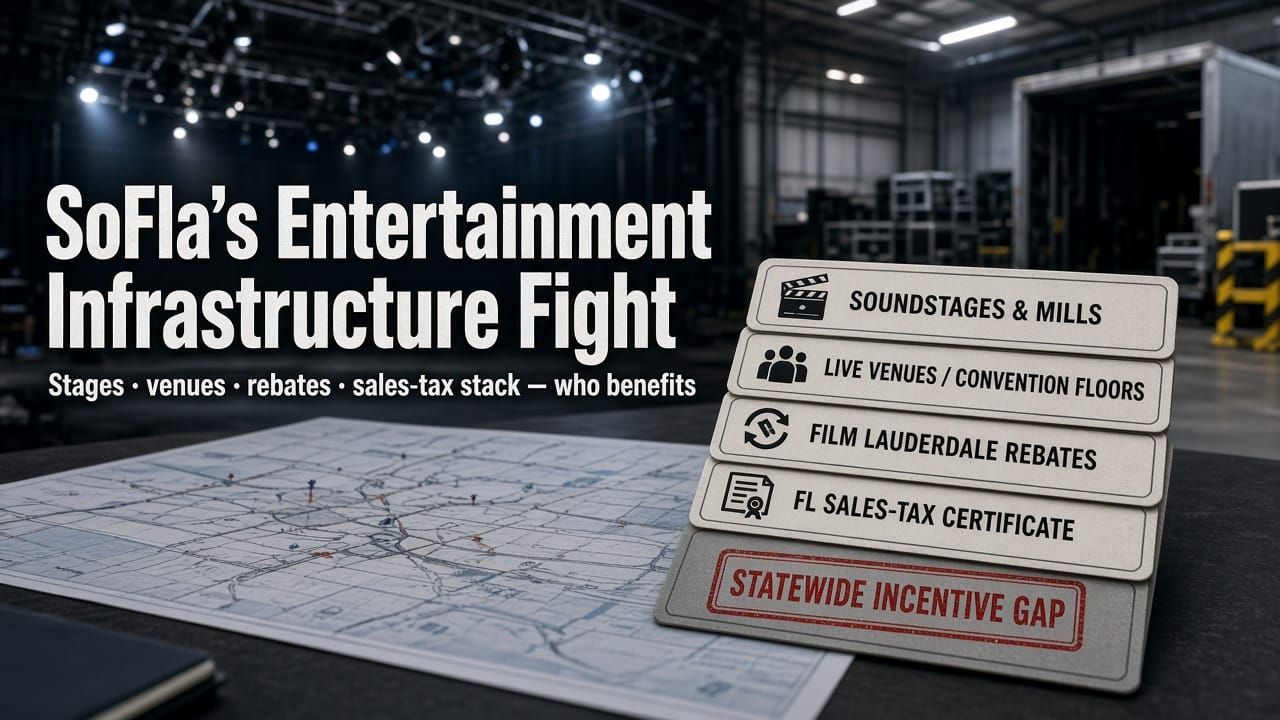
Statewide sales-and-use tax exemption (Film in Florida / DOR). Florida still offers a certificate path for qualified production companies to buy or lease certain production equipment and related items without sales tax, administered through the Department of Revenue’s Film in Florida program and tied to §288.1258, Florida Statutes. DOR describes 90-day certificates for Florida or non-Florida companies and 12-month certificates for Florida-based companies at a permanent Florida address (renewable annually up to five years). That is not a labor rebate and not a venue grant. It is a cost lever on gear, stages, and production-related rentals when the certificate is in hand before purchases. The Gazette’s owner how-to is live here: Florida entertainment industry sales-tax exemption.
County performance rebates — Broward / Film Lauderdale. Film Florida’s incentive roundup describes Film Lauderdale / Broward County as holding the largest local incentive fund for screen production in Florida. The published menu on Film Lauderdale’s incentive programs page (and mirrored by Film Florida) is performance-based: qualify on Broward spend and hiring rules, finish the work, document local payroll and expenditures, then receive a rebate. Applicants may apply to only one program per project. Published bands include:
- TV Commercial Attraction — 15% rebate, cap $175,000, minimum Broward spend $400,000
- Film & TV — 20% rebate, cap $800,000, minimum $400,000
- High Impact Film & TV — 20% rebate, cap $2 million, minimum $5 million
- Partial Project — 20% rebate, cap $500,000, minimum $1.5 million, at least five Broward production days
- Multiple Project Guarantee — 30% rebate, cap $2.5 million per project, minimum $4 million per project / $8 million aggregate across two projects in three years
- Scripted Series — 25% rebate, cap $5 million, minimum $12 million, full season of at least six episodes with distribution
- Emerging Filmmakers Grant — $10,000 match-required grant for Broward residents; Film Lauderdale notes applications may be submitted starting October 1, 2026 under updated criteria
Shared rules (vendor share, residency bands, Broward offices/stages on many programs, 120-day start clocks, 240-day post-wrap paperwork) are the operational reality. The Gazette’s practical map is here: Broward County film incentives / Film Lauderdale.
Statewide association and marketing layer — Film Florida. Film Florida is a 501(c)(3) membership association that markets Florida’s screen industry, networks commissions and vendors, and works with the Florida Department of Commerce and local film offices. After the former Office of Film and Entertainment’s transition into Commerce, Film Florida has described itself as carrying a heavier external marketing load. For owners, that means quarterly meetings, Governor’s Conference adjacency, and a published incentive index — not a substitute for a statewide labor credit. See the Gazette’s Film Florida Week West Palm owners brief.
Live-events and tourism floors already built in Broward. Broward County’s own Convention Center Expansion Project page documents a $1.1 billion initiative (county figure) to expand the Broward County Convention Center and add a headquarters hotel. The county reports the East Expansion grand opening on October 20, 2025, an expanded center of more than 1,200,000 square feet (including a 350,000-square-foot contiguous exhibition hall and a 65,000-square-foot waterfront ballroom), plus the 801-room Omni Fort Lauderdale grand opening on December 18, 2025. County messaging also cites an expected economic bolster of more than $450 million a year and more than 3,000 full- and part-time jobs — treat those as county projections, not independent audit results. For operators, the concrete assets matter more than the forecast: contiguous exhibit floor, waterfront ballroom, connector road access, hotel adjacency, and a waterfront plaza still opening into 2026. That is hospitality and event infrastructure that can support trade shows, branded activations, and production spillover even when a shoot never books the hall.
Palm Beach toolkit — different shape. Palm Beach County’s published film tools lean sponsorship, tourism TV, and permits more than Broward-style cash rebates. Film Florida’s Palm Beach County entry describes the Film & Television Commission’s Sponsorship & Development program tied to The Palm Beaches TV / tourism content with outside distribution — a content-and-tourism lane, not a 15–30% production rebate menu. County amphitheaters (Sunset Cove, Seabreeze, Canyon) remain live-event inventory for promoters and hospitality partners. Separately, Palm Beach County tourism planning has advanced a multi-year master-plan conversation around sports/entertainment arenas, immersive venues, and convention-center expansion concepts; treat those as study / planning items until construction and financing are awarded — not as opened stages on a rate card.
Indie and festival lanes that keep crews warm. Local calendars still move work while larger policy fights crawl: FLIFFShorts / Made in Broward, Dewey Film Festival Florida shorts, and Miami Media Festival Art Week adjacency. These are not substitutes for studio capacity. They are pipeline and proof-of-crew tools for content shops, rental houses, and post vendors.
The gap: federal floor talk, state hole, capacity questions
Florida’s statewide production incentive program ended in 2016. Trade and state reporting have repeatedly described Florida as the only Southeast state without a statewide film incentive. County patches and the sales-tax exemption do not close that structural gap when a location manager compares Florida to Georgia or other credit states. The Gazette’s twin brief on the federal drafting fight — Federal Floor, Florida Gap — covers the Motion Picture, Television, and Entertainment Revitalization Act draft as trade-reported (commonly ~20% labor base with possible uplifts toward ~30%), not enacted, with no public final bill text and calendar risk into a lame duck or 2027. Soft-flag every unpassed percentage. A federal credit, if enacted as trade describes, would still leave Florida without the federal-plus-state stack competitors can advertise unless Tallahassee restores a statewide tool.
Capacity is the other gap. Incentive dollars without stages, mills, and mid-size venues leave productions shopping hotels and warehouses. Stages without rebate clarity lose mid-budget commercials to counties that publish spend floors. Live-event venues without hotel adjacency leave promoters paying for shuttle logistics. SoFla’s opportunity is that Broward already pairs a large local rebate menu with new convention/hotel infrastructure — while Palm Beach and Miami-Dade add different tourism, arena, and content assets. The gap is not “Florida has nothing.” The gap is stacking honesty: do not sell a county rebate as a state credit, a tourism sponsorship as a labor incentive, or a tourism master-plan rendering as an opened arena.
Soft-flag the national “billions” chatter
National commentary about cities and states investing heavily in entertainment and sports infrastructure — including social chatter pointing at Southern California markets such as Anaheim — circulates as atmosphere. Soft-flag: do not treat unverified “billions” claims about Anaheim or SoCal as Florida comps, and do not invent Florida dollar counterparts to match them. Cite Broward’s published $1.1 billion convention-center-and-hotel project from the county’s own page when you need a Florida primary. Cite Film Lauderdale’s published rebate caps when you need production numbers. Leave California spend claims to California primaries. Gazette voice stays people-first: operators compete on documentation and delivery, not on dunking rival metros.
Who benefits when the stack works
Production shops and rental houses. Broward vendor-share and CBE/SBE rules push qualifying spend toward local businesses. Certificate-ready gear houses that can invoice cleanly inside a Duration of Project window become rebate-enablers, not just vendors.
Stages, mills, and content studios. Programs that require Broward offices and soundstages reward facilities that can host production offices, lighting packages, and wrap logistics. Mid-budget commercials clearing a $400,000 spend floor and High Impact / Scripted Series bands that demand millions in local spend both need physical capacity — not only permits.
Venues and promoters. Convention floors, amphitheaters, and future arena concepts create load-in calendars that feed AV companies, security, catering, and transportation. Live events and screen production share truck docks, hotel blocks, and labor pools even when the client is different.
Hospitality. Hotel nights tied to productions, festivals, conventions, and tours are the quiet multiplier. Broward’s Omni adjacency to the expanded convention center is an explicit tourism play; film rebates that require local spend pull rooms and F&B into the same corridor.
Indie and branded content studios. Brand work already uses county rebates and sales-tax certificates (see the Gazette’s branded-production rebate surge). Festival and shorts calendars keep emerging filmmakers and crews in motion between larger bookings.
What owners should watch in local policy and venue deals
Politics here only matters for owner impact — not for millage recaps.
1) County rebate fund health and program pauses. Film Lauderdale programs are subject to appropriation and fund availability. Emerging Filmmakers criteria updates and application windows (October 1, 2026 start for the updated grant) are live operational clocks. Watch Board and Film Commission communications for pause language before you promise a client a tier.
2) Pre-application and selection-committee routes. Scripted Series, High Impact, Multiple Project Guarantee, and Partial Project require Film Commission meetings and County Administration ROI screening. Owners pitching large work should budget relationship time, not only spreadsheet math.
3) Venue and tourism capital projects. Broward’s convention expansion and hotel are open or opening on published county timelines; plaza and restaurant pieces still have soft edges (county notes a deferred formal solicitation for an additional waterfront restaurant after an RFI). Palm Beach tourism master-plan “big ideas” (arena, immersive venue, convention expansion concepts) are feasibility/study territory until awards and sites are locked — useful signal for hospitality and AV positioning, not for inventing open dates.
4) CRA / district / public-private venue patterns. Redevelopment districts and entertainment-district framing often appear around arenas, amphitheaters, and hotel packages. Owner watch list: who controls booking calendars, whether local vendor preferences appear in development agreements, how bed-tax or tourism dollars are scoped for studies vs. construction, and whether film or special-event permitting is coordinated with the district. Do not invent award amounts; read the ordinance or agenda item.
5) Federal drafting without pricing it. Track Ways & Means text, bill numbers, and Joint Committee on Taxation scoring if and when they appear. Until then, keep two bid models: federal-only (if enacted) + county + sales-tax exemption versus county + sales-tax exemption alone. Do not reprint trade “60%+ stack” language as a Florida deliverable. Details live in the federal floor / Florida gap twin.
6) Statewide revival talk without over-promising. Incentive revival discussions recur in Tallahassee; treat them as owner-impact monitoring (details matter), not as a reason to delay building Broward or Palm Beach capacity.
How to position now
Build a one-page stack sheet. List (a) DOR certificate path, (b) which Film Lauderdale band fits your typical job size, (c) Broward vendor/CBE readiness, (d) stage or venue inventory you can actually book, (e) hotel packages within truck distance. Hand that sheet to line producers before they price Georgia.
Sell logistics as product. Power, parking, overnight security, union or non-union crew lists, tri-county residency proof workflows, and invoice formats that survive rebate audits are competitive advantages. Soft infrastructure wins when hard stages are scarce.
Pair live events and screen work on the same vendor roster. AV, catering, transportation, and hotels that can flip from a convention load-in to a commercial shoot keep utilization high. Cross-train sales language: “production weeks and event weeks” instead of siloed pitch decks.
Stay in the indie/festival pipeline. Emerging Filmmakers, FLIFFShorts, Dewey, and Miami Media Festival calendars are not vanity — they are casting, crew, and brand-relationship warmers while larger RFPs move slowly.
Watch Palm Beach and Miami adjacency without forcing Broward rules onto them. Price Palm Beach sponsorship/tourism tools as what they are. Do not invent a Broward-style rebate where Film Florida’s published Palm Beach entry describes sponsorship programming.
Keep rate cards clean of unpassed federal percentages. Market labor depth and facility readiness for U.S. spend. Reopen pricing language if enacted federal terms arrive.
Bottom line for SoFla operators
The entertainment-and-live-events boom is an infrastructure competition. Florida already fields a statewide sales-tax certificate, Broward’s largest-in-state local rebate menu, Film Florida’s marketing layer, new Broward convention and hotel capacity on county-published figures, Palm Beach amphitheaters and tourism-content tools, and a busy indie festival calendar. The structural gap remains a missing statewide production credit since 2016 — with federal drafting still soft and competitor states able to advertise dual stacks Florida cannot match today. Soft-flag unverified out-of-state “billions” chatter; cite Florida primaries instead.
Who benefits: production shops, stages, venues, hospitality, and content studios that can document local spend and host the work. What to watch: rebate appropriations, venue and tourism capital calendars, CRA/district deal terms that touch booking and vendors, and federal text only when it exists. How to position: stack sheets, logistics as product, live-event and screen cross-selling, and clean rate cards. The operators who treat stages, venues, crews, and hospitality as one economic system — not separate hobbies — will be ready when the next production or tour stop prices South Florida against everywhere else.