By Brian D’Antoni
Sundaze Gazette · Palm Beach County / Property Tax & Budget
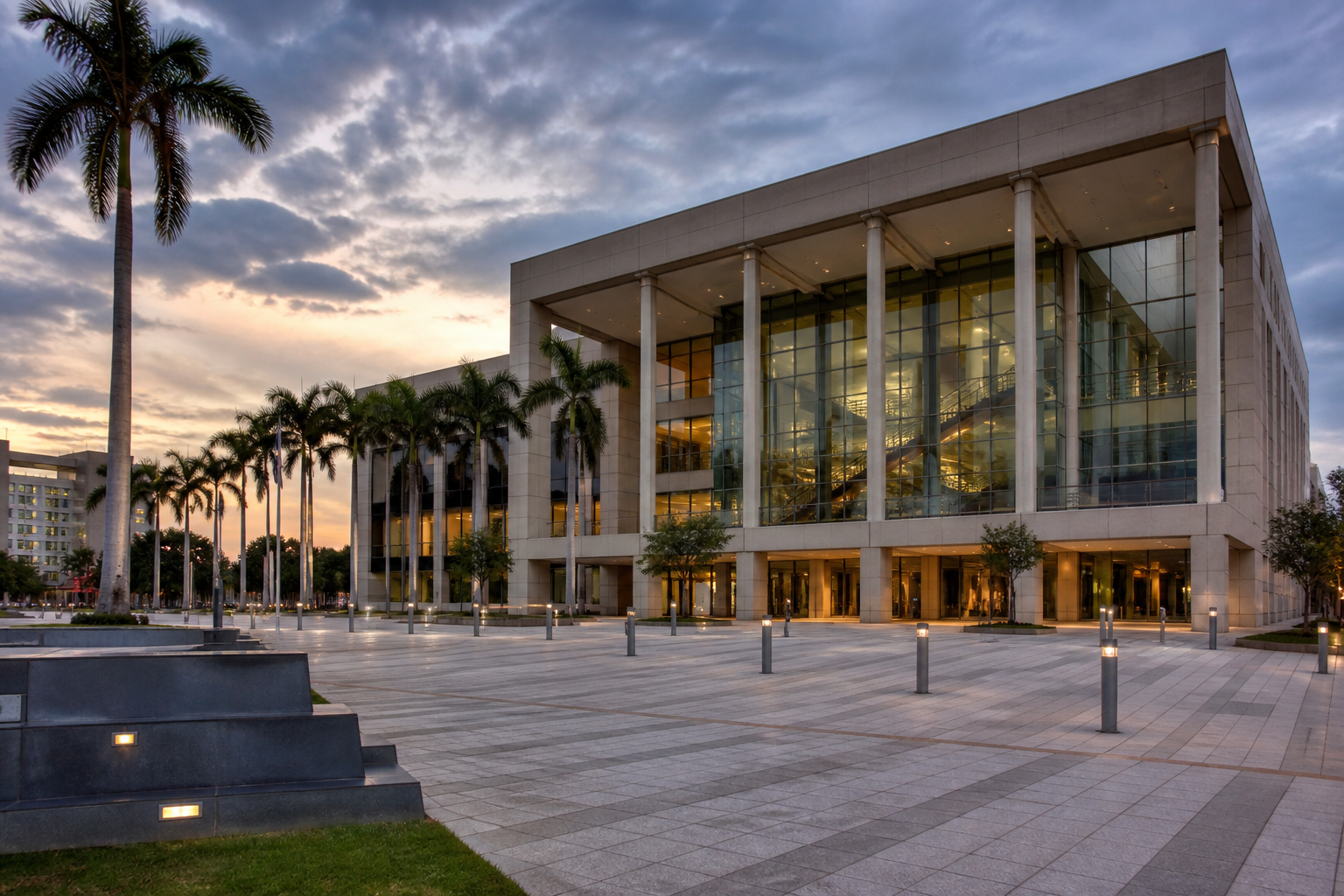
With a Sept. 11 refresh ahead of Monday’s final hearing, the chamber on the sixth floor of the Robert Weisman Governmental Center will do the work Florida’s Truth in Millage calendar reserves for mid-September: take the tentative millages and budgets advanced at the first public hearing and move toward final adoption before the county’s new fiscal year opens on October 1.
Monday, September 15, 2026, 5:05 p.m.
Robert Weisman Governmental Center · Commission Chambers, 6th Floor
301 N Olive Avenue · West Palm Beach
That clock matches the first hearing held September 3 at the same place and the same 5:05 p.m. start—statutorily required to begin after 5:00 p.m. Both dates appear on the county’s FY2027 Annual Budget hub. The hub still lists the Sept. 3 package as the downloadable hearing document. As of Monday, September 7, 2026, a Sept. 15 final/second-hearing package was not posted on that hub. Do not fill that gap with last year’s second-hearing PDFs, secondary press summaries, or invented “final” millages. Until the Board adopts finals on Sept. 15 (and staff posts the controlling packet), the only package-backed county millage table for FY2027 in this report is the tentative set from the September 3rd 1st Public Hearing Package.
This is not a line-by-line rewrite of the county’s budget document. It is an owner-facing map: what Sept. 3 already put on the table, what Sept. 15 can still change before Oct. 1, how to read your TRIM notice without confusing it for a bill, and what to do this week if you intend to speak, watch, or track late packet uploads.
The Sept. 3 tentative rates (package only — still not final)
The Sept. 3 package balances the countywide proposal at 4.5000 mills—the same countywide operating rate as FY2026—and frames that rate as 5.44% over the rolled-back rate of 4.2678. Voted debt millage in that package is 0.0210. Package notes place the countywide proposed levy roughly $85,302,887 above what the rolled-back countywide rate would produce. A separate motion in the package covers fund transfers and amendments totaling $94,215,736.
Dependent-district and aggregate figures in the same tentative package:
| Levy (tentative, Sept. 3 package) | Proposed mills | Rolled-back | % over rolled-back |
|---|---|---|---|
| Countywide operating | 4.5000 | 4.2678 | 5.44% |
| Countywide voted debt | 0.0210 | — | — |
| Library | 0.5491 | 0.5213 | 5.33% |
| Fire-Rescue MSTU | 3.4581 | 3.2856 | 5.25% |
| Aggregate (as shown in package) | 6.1889 | 5.9577 | 3.88% |
Labels matter. These are tentative rates from the first-hearing package. They are not adopted FY2027 finals. This Gazette package does not invent a countywide budget dollar total beyond what owners can confirm in the PDF themselves; if you need a single “total budget” figure for a lender brief or association packet, open the Sept. 3 package (and any later Sept. 15 packet) and cite the page—do not rely on a secondary paraphrase.
Rolled-back rate, in plain English: it is the millage that would generally raise the same ad valorem revenue as the prior year on the new taxable roll (subject to the statutory computation). A proposed rate above rolled-back is what Florida’s TRIM process requires officials to announce as a percentage increase in property taxes relative to that baseline—even when the headline millage number is unchanged year over year. That is why a flat 4.5000 can still sit 5.44% over rolled-back when the tax base grows.
What Sept. 15 can still amend before Oct. 1
Florida’s Truth in Millage process (see s. 200.065, F.S. and the Florida Department of Revenue’s homeowner millage guide and TRIM workbook) draws a bright line owners often miss:
- Final millage cannot exceed the tentatively adopted millage from the first hearing, unless the taxing authority restarts the notice process (including additional mailed notice to taxpayers). In ordinary practice for this calendar, that means Sept. 15 is a ceiling hearing for the rates already tentatively adopted—not an open auction higher than Sept. 3.
- The Board can adopt a lower millage than the tentative rate. Statewide, millage decreases do not face the same upward-restart constraints.
- The Board can amend the tentative budget at the final hearing—“as it sees fit” in the statute’s language—then adopt a final budget and a millage resolution/ordinance by separate votes. Millage is adopted before the budget at the hearing.
- Public comment is part of the hearing, not a courtesy sidebar. The TRIM notice and interactive guide both tell owners the hearings exist to receive opinions and answer questions before final action, and that each taxing authority may amend or alter its proposals at the hearing.
- Fiscal year 2027 starts October 1, 2026. After finals are adopted, the Tax Collector’s November bill cycle is what converts adopted millages and taxable values into the payment you actually owe (subject to early-payment discounts). Sept. 15 is the county’s last scheduled TRIM hearing on this track before that year begins.
What owners should not expect Sept. 15 to be: a redo of your Property Appraiser market-value dispute, a substitute for a Value Adjustment Board petition, or a single vote that sets school-board, city, or independent-district millages that hold their own hearings. Countywide, library, Fire-Rescue MSTU, and other BCC-controlled funds on the county hearing agenda are the lane in this chamber. Everything else stays with its own taxing authority.
Package gap, stated plainly: watch the FY2027 budget hub and the meeting-dates page for a second-hearing packet, agenda attachments, and any advertised amendments. If staff bring dais amendments reflecting items discussed after Sept. 3, those belong in the posted materials or the live record—not in speculation. This report will not claim final rates.
What changed after the Sept. 3 tentative vote
The Sept. 3 hearing advanced the tentative rates and budgets. It also left a return list for the final hearing. Per the live Boca Post report on the Sept. 3 hearing (published Sept. 5, 2026):
- Commissioners advanced the flat 4.5000 countywide rate on a 5–2 roll call and adopted the related tentative library, Fire-Rescue MSTU, MSTD, and aggregate motions described in that report and the hearing package.
- Staff said they would bring amendments to the Sept. 15 hearing reflecting spending the board directed from the dais—including full-year funding direction for the Jim Brandon Equestrian Center and restoration of about $79,000 for the Palm Beach Soil and Water Conservation District, plus handling of roughly $2.5 million tied to a Clerk supplemental request that was withdrawn.
- The board directed staff, 7–0, to obtain a detailed Sheriff’s Office budget at the sub-object level (including a jail breakout)—process for Monday’s packet watchers, not a millage change by itself.
- The tentative budget materials already removed about $7.5 million in proposed beach parking revenue from Parks and Recreation (listed as a General Fund amendment in the hearing package narrative covered by Boca Post).
- A bond refunding that staff said would save about $7.93 million over the remaining life of the debt was flagged for board action the same day as the final millage hearing.
Owner read, not theater: Monday is not a blank slate. Under ordinary TRIM practice, final millage cannot exceed the tentatively adopted millage without restarting taxpayer notice; the Board can adopt a lower rate and can amend the tentative budget before final adoption (see s. 200.065 and the DOR guides linked above; fuller ceiling language is in the Sept. 7 Gazette map). What owners should watch this weekend is whether OFMB posts a Sept. 15 second-hearing package with the dais amendments and any refunding backup—and whether Monday’s adopted resolutions match the tentative millage table or move lower.
Do not treat Boca Post’s narrative totals (gross county budget, General Fund share, pay adjustments, position counts) as a substitute for the OFMB PDF when you brief a lender. Prefer the Sept. 3 package and any later hub upload.
Same-day bond refunding (~$7.93M) — track on the agenda
Staff flagged a bond refunding for the same day as the final millage hearing, with estimated savings of about $7.93 million over the remaining life of the debt, according to the Boca Post Sept. 5 report. That is a debt-service / refinancing item on the board day—not a change to the countywide 4.5000 operating millage by itself.
Owner action: When the Monday agenda and any Sept. 15 budget package post, locate the refunding item, note the stated savings figure and series being refunded, and keep it separate from your TRIM Column 3 millage markup. Do not invent a millage cut from a refunding headline. If the refunding backup is only in live agenda attachments, cite those attachments—not a paraphrase.
Weekend action checklist (Fri Sept. 11 → Mon Sept. 15)
Friday (today)
1. Re-open your 2026 TRIM. Confirm “not a bill.” Highlight Column 3 vs Column 2 for county, Library, and Fire-Rescue MSTU lines that apply to your parcel.
2. Download / re-open the Sept. 3 first-hearing package and annotate the tentative table above against the PDF pages.
3. Bookmark the FY2027 hub. Check once for a Sept. 15 second-hearing package or agenda backup. If it posts after this story’s deadline, the newer PDF controls.
4. Skim the Boca Post Sept. 3 hearing wrap for the amendment return list (Jim Brandon, Soil and Water, Clerk $2.5M handling, Sheriff detail, refunding)—then verify dollars against county PDFs when posted.
Saturday
5. Decide your lane: rates, budget amendments within the tentative frame, refunding clarification, or something that belongs at PAO/VAB instead.
6. Draft a 90-second comment (or a short written note if the meeting materials allow filing). Include parcel ID and the millage line you are addressing.
7. Map your full stack—city, schools, MSTU/library applicability, independent districts—so Monday’s county vote is not the only number you brief to a spouse, board, or lender.
Sunday
8. Confirm travel to 301 N Olive Ave, 6th Floor chambers, for a 5:05 p.m. start. Build a buffer for security and seating.
9. Print TRIM + Sept. 3 package table (or save offline PDFs). Screenshot alone is not a substitute for the OFMB document.
10. Recheck the hub and any posted BCC agenda for Monday attachments.
Monday
11. Attend or designate a watcher. Note whether staff presents amendments matching the Sept. 3 dais direction and whether millage resolutions adopt the tentative rates or move lower.
12. After adoption, look for resolutions/ordinances and Tax Collector November bill instructions—not for TRIM to morph into a payment coupon.
13. If value/exemption issues remain unresolved, return to PAO informal review / VAB deadline on your notice (561.355.2866 / 561.355.6289).
TRIM literacy: not a bill, and a mill is $1 per $1,000
Your Notice of Proposed Property Taxes—the TRIM notice—is not a bill. The Palm Beach County Property Appraiser’s 2026 TRIM insert and interactive guide open with that warning for a reason. The notice estimates proposed taxes from January 1 values and proposed rates so you can attend hearings before rates are finalized. Payment comes later, on the Tax Collector’s bill.
Millage is the rate: one mill = $1 of tax per $1,000 of taxable value. Formula:
Taxable value ÷ 1,000 × millage rate = tax for that authority
Example from the PAO insert logic: taxable value $425,000 at 8.000 mills → 425 × 8.000 = $3,400 for that rate stack piece. Your real notice will show different taxable values for school vs. non-school lines when homestead and other exemptions apply unevenly—read the columns, do not average them by eye.
TRIM columns (as the interactive guide explains):
- Column 1 — Last year: taxes that applied last year on last year’s budgets and prior taxable value.
- Column 2 — If no budget change: what this year’s taxes would be if each authority kept last year’s levy posture against this year’s taxable value (the “no budget change” comparison).
- Column 3 — If proposed budget change is adopted: taxes under each authority’s proposed rate. The guide is explicit: proposals are not final and may be amended at the listed hearings. The difference between columns 2 and 3 is the change proposed by the taxing authority—not simply “assessment went up.”
Non-ad valorem assessments (solid waste, drainage, lighting, CDD debt/O&M, and similar) can appear on the same notice. They are not millage. They are service or district assessments set by their levying boards. Your November bill may include assessments that were not on the TRIM face. Early-payment discounts (up to 4%) apply to the tax bill side as described on the notice—amounts on TRIM do not already bake those discounts in.
Stacked taxing authorities: why one rate never tells the whole story
A Palm Beach County parcel typically sits under a stack: county operating (and any county debt), municipality (if inside a city), public schools (state-law and local-board lines), dependent districts such as Library and Fire-Rescue MSTU where applicable, plus independent districts (water management, Children’s Services Council, Health Care District, navigation, and others as listed on your notice).
That is why “the county kept the rate flat” is only one slice of a November bill. Library and Fire-Rescue MSTU millages in the Sept. 3 tentative package are separate lines from countywide operating. School millages run on the school board’s calendar and hearings. City rates belong to your municipality. Owners comparing neighbors across municipal boundaries, MSTU boundaries, or homestead vs. non-homestead status are often comparing different stacks, not a single countywide number.
Practical habit: when you mark up your TRIM, circle every hearing date on the right-hand hearing list, not only the county’s. Sept. 15 is decisive for the county’s final adoption track; it is not a master switch for every line on the page.
Value disputes are a different track (PAO / VAB)
Millage hearings set rates. The Property Appraiser sets values, exemptions, and classifications as of January 1. If you believe market value is wrong, or an exemption/classification is missing, the PAO’s own materials point you first to an informal review with the Property Appraiser’s Office, then—if unresolved—to a Value Adjustment Board (VAB) petition. Deadline language lives on your TRIM notice; the PAO insert lists VAB information at 561.355.6289. Main PAO line: 561.355.2866 · pbcpao.gov.
Speaking at a millage hearing about “my assessment is too high” may get you a polite redirect. It does not substitute for the PAO/VAB clock. Keep the lanes separate: rates at the BCC hearing; value and exemptions at the Appraiser and VAB.
Owner checklist — before Sept. 15
- Re-open your 2026 TRIM notice. Confirm it is labeled as a notice of proposed taxes, not a bill. Highlight Column 3 proposals vs. Column 2 “no budget change.”
- Pull the controlling county packet: Sept. 3 first-hearing package. Annotate the tentative millage table above against the PDF pages—not against memory.
- Check the FY2027 hub daily this week for a Sept. 15 second-hearing package or agenda backup: annual-budget-2027.aspx. If it posts after this story’s deadline, the new PDF controls.
- Calendar the hearing: Mon., Sept. 15, 2026, 5:05 p.m., Chambers, 6th Floor, 301 N Olive Ave, WPB. Arrive early; TRIM hearings can draw standing-room attendance.
- If you will speak: prepare one concrete ask tied to what the second hearing can still do—e.g., support for holding or lowering a rate within the tentative ceiling, a specific budget amendment question, or a request that staff clarify a transfer line. Bring parcel ID and taxable-value figures from your notice.
- If you cannot attend: use the county’s published comment channels for that meeting (Clerk / BCC public-comment instructions on the agenda or meeting page when posted). Written comment is process, not a substitute for watching whether the final package changes numbers.
- Separate your tracks: value/exemption issues → PAO informal review / VAB petition deadline on your notice. Millage/budget → Sept. 15 hearing.
- Map your full stack: city, schools, MSTU/library applicability, independent districts. Do not brief a spouse, board, or lender on “the county rate” alone.
- Watch for advertisements of the final hearing and any required percent-over-rolled-back announcements in the live adoption script. Statute requires public announcement of the rolled-back comparison before millage adoption.
- After Sept. 15: look for adopted resolutions/ordinances and the Tax Collector’s November bill instructions—not for TRIM to morph into a payment coupon.
FAQs
Are the 4.5000 / 0.5491 / 3.4581 figures final?
No. They are tentative figures from the Sept. 3 first-hearing package. Finals are what the Board adopts at the Sept. 15 hearing (or any lawful continuation). This package will not invent finals.
Can the county raise millage above the Sept. 3 tentative rates on Sept. 15?
Under Florida TRIM practice summarized by the Department of Revenue, once a tentative millage is set, the authority cannot adopt a higher final millage without restarting the process (including additional taxpayer notice). It can adopt a lower rate. Treat the tentative rate as a practical ceiling for the ordinary final hearing.
Why does a “same as last year” 4.5000 still show 5.44% over rolled-back?
Because rolled-back is a revenue baseline on the new tax roll, not a promise that an unchanged millage number equals an unchanged levy. Growth in taxable value means the same millage can collect more dollars than last year’s rolled-back comparison.
Is my TRIM notice a bill I must pay now?
No. It is a notice of proposed taxes and hearing information. The tax bill comes later from the Tax Collector.
Does Sept. 15 set my school or city tax rate?
Not as a substitute for those authorities’ own hearings. Attend or track each hearing listed on your TRIM for each line that taxes your parcel.
What about the $94.2 million transfers motion?
The Sept. 3 package includes a motion path for budget transfers/amendments totaling $94,215,736. That is package language about fund movements and amendments in the tentative budget materials—not a second millage rate. Read the package pages for what moves where; do not equate “transfers total” with “tax increase total.” The ~$85.3 million figure tied to countywide proposed vs. rolled-back is the package’s revenue-over-rolled-back note for the proposed countywide rate.
Where do I fight my assessed value?
Property Appraiser informal review first; VAB petition if needed. Contacts: 561.355.2866 (PAO) · 561.355.6289 (VAB info). Deadline: on your TRIM notice.
What if the Sept. 15 package still is not posted the morning of the hearing?
Bring the Sept. 3 package, your TRIM, and a notepad. Ask on the record where the final backup lives. Do not accept a social-media screenshot as a substitute for the OFMB PDF or the adopted resolution.
What to do this week (Sept. 7–15)
Print the tentative table. Watch the hub for the missing final package. Decide whether you are speaking about rates, budget amendments within the tentative frame, or something that actually belongs at the PAO/VAB. Put 5:05 p.m., Sept. 15, 301 N Olive on the shared household calendar. Fiscal year 2027 does not wait for anyone’s unread email—October 1 arrives on schedule either way.
Sundaze Gazette will treat any later-posted Sept. 15 package as controlling for final-rate reporting. Until then, every millage number in this story stays labeled what the county’s first-hearing package says it is: tentative.
Source notes (end matter)
Primary documents and statute pages listed in the package header. All millage and rolled-back figures in the body table are attributed to the Palm Beach County OFMB September 3rd 1st Public Hearing Package and remain tentative pending Board action at the Sept. 15, 2026 second public hearing. Hearing times/locations confirmed on the FY2027 Annual Budget page as of Sept. 7, 2026. TRIM definitions drawn from PAO 2026 inserts/guides and Florida DOR homeowner millage materials. No FY2025 second-hearing PDFs used as proxies for FY2027 finals.