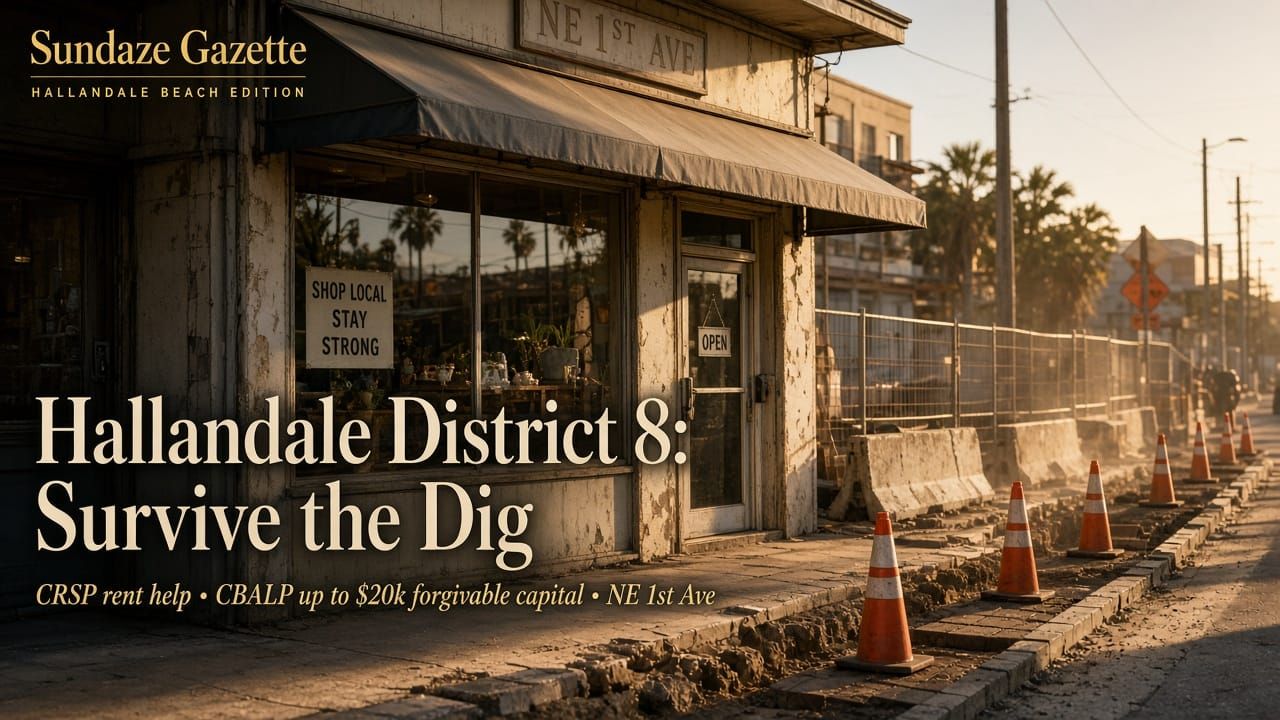
If you run a storefront on Hallandale Beach’s NE 1st Avenue corridor while the District 8 streetscape is under construction, the useful question is not whether the CRA “has grants.” It is whether public construction money and same-corridor survival capital are still available for your address, this impact phase, and a documented revenue hit—before first-come funds are gone.
The Hallandale Beach Community Redevelopment Agency (HBCRA) built a two-track District 8 Construction Mitigation Program for businesses directly affected by the NE 1st Avenue Streetscape Improvement Project: the Construction Rent Stabilization Program (CRSP) and the Construction Business Assistance Loan Program (CBALP). This is owner-impact CRA money timed to the dig—not a brochure façade grant, not a general “apply someday” incentive list.
Canonical sources (re-verified for this package):
- District 8 Hallandale Beach Construction Updates
- Business Programs & Incentives (District 8 Construction Mitigation section)
- CRSP Application PDF (created February 2026)
- CBALP Application PDF (revised February 2026)
Construction contact named on the live updates page: Bowe Kenneth — kbowe@hallandalebeachfl.gov / (954) 457-2221.
Application appointments (both program PDFs): call (954) 457-2228 before you show up. Walk-ins are not how these packets get filed.
Who this is for (and who it is not)
| You are… | Read this package as… |
| --- | --- |
| Existing District 8 storefront on NE 1st Ave from Hallandale Beach Blvd to NE 5th St, open to the public, with an active Hallandale Beach Business Tax Receipt (BTR) | Primary audience |
| Documenting ≥20% revenue decline vs. the six months before construction started, tied to construction impact | Eligibility core for both tracks |
| Tenant (or owner-operator) whose frontage / primary access sits in a verified construction impact zone during an active phase | Confirm zone + phase with HBCRA staff before you assemble the full packet |
| New business that opened or relocated to the corridor after streetscape construction began | Out under both program PDFs—no pre-construction operating history |
| Landlord who leases to someone else and does not operate a business on site | Not eligible for CRSP mortgage help; tenant path still requires joint owner/tenant paperwork |
Wrong geography, wrong phase, closed doors, or a revenue story you cannot document are the expensive “almost eligible” mistakes. HBCRA staff verify direct impact and the applicable phase timeline—not a neighbor’s guess.
Why now: the dig is live, and the money is phase-tied and funds-limited
HBCRA’s construction updates page describes an 18-month streetscape job done in phases, with Maintenance of Traffic (MOT) updates posted monthly. Complete Phase II work listed on that page includes drainage, curb/sidewalk/ADA ramps, decorative paver crosswalks, irrigation/electrical rough-in, and brick-paver parking prep. Upcoming Phase III work includes pavement removal, drainage and waterline work, grading, base and concrete, brick pavers, first asphalt lift, and temporary striping.
While that work improves long-term walkability and corridor vitality, the Agency’s own mitigation language names the short-term pain owners already feel: accessibility, visibility, parking, and customer traffic. Mitigation capital exists because occupancy and employment on the corridor matter during redevelopment—not as a consolation brochure.
Two timing rules matter more than marketing copy:
- CRSP assistance is framed around the construction impact window—up to twelve (12) months, tied to the phase affecting your storefront.
- CBALP is a one-time, first-come, first-served forgivable loan, subject to availability of funds. Waiting until “the worst month” can mean the pool is already committed.
Supporting corridor tools on the construction page (shuttle loop, temporary free CRA lots during a published window, paid on-street parking otherwise) help customers reach you. They do not replace rent or operating capital if your books already show a construction-linked drop.
The two-track ladder in one screen
Track A — CRSP (Construction Rent Stabilization Program)
Temporary rent (or, for qualifying owner-operators, mortgage principal-and-interest) subsidy: up to 50% of the monthly rent or mortgage obligation, for up to 12 months, during documented construction impact. Not a cost-reimbursement build-out grant. Subsidy issues after you pay the remaining tenant share, with proof of payment.
Track B — CBALP (Construction Business Assistance Loan Program)
One-time forgivable loan of up to $20,000 per eligible business in the defined impact area. HBCRA’s business-programs page and CBALP “About / Basis” language describe uses such as payroll, inventory, marketing, and operations needed to stay open during construction. Awarded first-come, first-served, funds limited. Forgiveness is described on the business-programs page as 50% annually over a two-year compliance period if you remain open and compliant—confirm the controlling forgiveness schedule and compliance length with staff when you book your appointment, and make sure the agreement you sign matches what you budgeted.
Shared eligibility spine (both tracks, per HBCRA business-programs page + both PDFs):
- Location in District 8 along NE 1st Avenue (Hallandale Beach Blvd to NE 5th St) inside a staff-verified construction impact zone during an active phase
- ≥20% documented revenue decline vs. average revenue in the six (6) months preceding commencement of construction, attributable to construction-related impacts
- Active BTR (applications call for current and prior-year copies)
- Remain open and operational to the public during the assistance period (closures for renovations or voluntary shutdowns unrelated to the project do not qualify for CRSP subsidy periods)
- Business was operating on the corridor before streetscape construction began
Submission of an application is not a guarantee of funding. Funding is subject to eligibility, fund availability, and HBCRA approval processes described in each PDF.
Desk map: who to call, what to bring
| Need | Desk | How |
| --- | --- | --- |
| Construction impact, phase, MOT, corridor operations | Bowe Kenneth | kbowe@hallandalebeachfl.gov · (954) 457-2221 |
| Confirm impact zone / active phase for your storefront | HBCRA staff (start with construction contact; confirm at application appointment) | Same numbers + construction updates page |
| CRSP / CBALP intake appointment (required; no walk-ins for package drop) | HBCRA staff | (954) 457-2228 · cohbcra.org |
| Program overview + other CRA business tools | Business Programs & Incentives | Program hub |
One clean call or email script: legal business name; storefront address on NE 1st Ave; owner vs. tenant; whether you operate on site; BTR status; approximate month revenue dropped ≥20% vs. the six months before construction; which phase you believe is adjacent to your frontage; whether you need rent help (CRSP), operating capital (CBALP), or both; and whether the property has open liens, judgments, or code issues you already know about.
Bring that same fact set to the (954) 457-2228 appointment before you print the full checklist.
CRSP deep dive: rent (and owner-operator mortgage) timed to the impact window
What it is. Temporary rental assistance so eligible District 8 businesses can keep meeting lease obligations while an active streetscape phase hits visibility, access, parking, and foot traffic. HBCRA frames it as business retention and vacancy prevention during redevelopment—not as a permanent rent program.
Dollar shape (verified from construction updates page, business-programs page, and CRSP PDF):
- 50% of the tenant’s monthly rent obligation
- Maximum duration: up to twelve (12) months
- Owner-occupied commercial operators on the eligible property may seek mortgage assistance under the same percentage and duration limits, limited to the principal and interest portion of the payment—and only if the owner actively operates the business on that property
- Landlords who only lease to third parties are not eligible for mortgage assistance under CRSP
- Assistance does not cover past-due rent from before the construction impact period
- Disbursement: tenant pays the remaining share first; then subsidy processes with proof of payment under HBCRA procedures
Lease / applicant structure (CRSP PDF). Property owner and tenant are joint applicants. Tenant side expects a current multi-year lease with a minimum of two (2) years remaining at application (automatic disqualification if that bar is missed). Owner side expects stable lease terms appropriate to the location through the grant period. Tenants generally cannot file alone without written owner authorization; applications must be signed by the owner of record unless an authorized-agent path acceptable to HBCRA counsel is documented.
Eligible use types (non-exhaustive, per PDF): retail/merchandise; restaurants and food service; personal services and wellness; creative/arts/cultural; professional services and destination retail; other commercial uses open to the public as HBCRA determines.
Automatic outs owners should screen for early (CRSP PDF): less than 20% documented construction-linked revenue decline; not open to the public during requested months; insufficient lease term remaining; unresolved municipal liens, code violations, or judgments; location outside the verified impact zone / inactive phase; business established or relocated to the corridor after construction started; incomplete or misleading packet; prior rescinded awards, defaults, or active/threatened litigation against HBCRA or the City as listed in the PDF; religious primary use / schools / tax-exempt nonprofits unless HBCRA determines otherwise under applicable law.
How to apply (CRSP PDF process, condensed):
- Schedule an appointment — (954) 457-2228.
- Submit in person only (not email/mail): one hard copy + one electronic copy of the complete packet, plus a $250.00 check payable to the City of Hallandale Beach Community Redevelopment Agency (fee stated on the CRSP application/checklist).
- Incomplete packets wait until complete.
- HBCRA targets review within 30 business days of receipt and may request missing items.
- Applications meeting criteria may be approved administratively by the HBCRA Executive Director (PDF states board consideration is not required for that administrative path). Approval is still not an entitlement.
- Expect a Grant Agreement and related recorded documents on the timeline in the PDF; execute within the stated window after approval.
- Ongoing: proof of monthly rent payment before each subsidy issue; stay open; keep the property free of the lien/judgment problems the agreement requires.
Checklist highlights you should prep before the appointment (CRSP PDF): signed lease; one-page marketing plan for customer activity during construction; current and prior-year BTR; property/business insurance; hardship/impact statement with dates and phase; landlord W-9 and payment-request form; financials/POS/P&L/sales summaries showing the ≥20% drop vs. the six months pre-construction; proof you remain open; proof of rent payments for subsidy requests; authorized-agent docs if needed.
Primary PDF: DISTRICT-8-CRSP-APPLICATION-1.pdf.
CBALP deep dive: up to $20,000 forgivable operating capital, first-come
What it is. A temporary economic stabilization forgivable loan for existing District 8 businesses in the verified construction impact area that need operating runway—not a façade makeover and not a substitute for curing code cases.
Dollar shape (verified):
- Up to $20,000 one-time forgivable loan per eligible business
- First-come, first-served, subject to fund availability
- HBCRA issues funds to the approved applicant after verification of eligible costs—not directly to vendors, contractors, employees, or other third parties
- Business-programs page eligible-cost examples: payroll, inventory, marketing, and other costs necessary to sustain business activity during construction
- CBALP PDF eligible-cost examples similarly include inventory for ongoing operations, limited employee-retention/workforce stabilization support (documented and staff-approved), and marketing/outreach to keep visibility during construction
Forgiveness (confirm at appointment). The live business-programs page and the CBALP About/Basis sections describe forgiveness over a two-year compliance period at 50% per year if you stay open, operational, licensed (including valid BTR), and inside program terms. Other sections of the same PDF discuss a longer compliance framing. Do not guess which schedule controls your award. Ask staff which document and agreement language govern your loan before you count the money as forgiven on a spreadsheet.
Lease bar to screen early. CBALP automatic-disqualification language requires a valid executed lease with a minimum of four (4) years remaining at application (stricter than CRSP’s two-year remaining bar). Basis language also requires a lease term sufficient to cover the compliance period, or written assurance of continued tenancy acceptable to HBCRA. If your lease is short, fix that conversation with your landlord before you pay application costs.
Who is in / out (high level). Established, operating, public-facing commercial uses in the impact zone that were open before streetscape construction; qualified retail/service categories listed in the PDF (food service, merchandise, service retail, destination/specialty retail, professional services, small theatre, fitness, co-working, performing/creative arts, and other uses as approved). New businesses, new office uses without prior operations at the location, and businesses that cannot show foot-traffic-dependent qualified retail/service operations face the PDF’s disqualification screens. Duplicate HBCRA funding for the same costs is barred. Closing, relocating out of District 8, or unapproved ownership transfer can make the remaining unforgiven balance immediately due.
How to apply (CBALP PDF process, condensed):
- Appointment — (954) 457-2228.
- In-person submission only; hard copy + electronic copy; $250.00 non-refundable application fee payable to the City of Hallandale Beach Community Redevelopment Agency (fee stated on the CBALP application/checklist).
- Owner-of-record signature rules mirror the seriousness of CRSP—tenants need written owner authorization if they are not the owner.
- First-come review against available funds; completeness review targeted within 30 business days.
- Administrative approval path via HBCRA Executive Team / Executive Director as described in the PDF; then execute the Program / Forgivable Loan Agreement (and any required recorded documents) within the stated window.
- Keep records of fund use for the retention period in the PDF; expect possible site visits and monitoring for continued operations, BTR, and District 8 location.
Checklist highlights (CBALP PDF): proof of District 8 impact-area address; multi-year lease; current and prior-year BTR; insurance; impact statement; revenue-decline documentation; description of fund use; quotes/invoices/cost estimates for proposed eligible expenses; proof you are open; photos and other packet items listed on the checklist; post-approval vendor registration and W-9 for payee as required.
Primary PDF: DISTRICT-8-CBALP-APPLICATION.pdf.
CRSP vs. CBALP: which track first, can you pursue both?
| Question | CRSP | CBALP |
| --- | --- | --- |
| Primary job | Keep rent/mortgage (P&I) current during impact months | Inject operating capital (payroll, inventory, marketing, etc.) |
| Cap shape | 50% of monthly rent/mortgage, up to 12 months | Up to $20,000 one-time |
| Clock | Tied to construction impact / phase window | First-come; funds limited; multi-year compliance after award |
| Lease remaining (PDF screens) | ≥2 years remaining | ≥4 years remaining (disqualification language) |
| Owner-operator mortgage path | Yes, if you operate on site (P&I only) | Loan is business operating assistance, not a rent-share formula |
| Stay open | Required for assisted periods | Required through compliance |
HBCRA’s construction-mitigation framing presents two complementary initiatives. Whether your facts support one or both is a staff eligibility question—especially on lease length, impact-zone proof, revenue documentation, and any “same costs / duplicate funding” screen on CBALP. Do not assume stacking without asking at the intake appointment. If cash-flow pressure is rent-first, start the CRSP checklist and impact-zone confirmation in parallel with a CBALP eligibility ask so you do not burn weeks on the wrong form.
Owner action checklist (this week)
- Confirm geography and phase. Match your frontage to NE 1st Ave between Hallandale Beach Blvd and NE 5th St, then ask HBCRA whether you sit in the current construction impact zone for an active phase. Start with Bowe Kenneth at kbowe@hallandalebeachfl.gov / (954) 457-2221, and bookmark the construction updates page.
- Pull the revenue proof. Assemble six months pre-construction averages and the impact-period figures (POS, sales summaries, P&L, financial statements) that show ≥20% decline attributable to construction. Vague hardship letters without numbers stall both tracks.
- Verify BTR and “open” status. Current and prior-year BTR copies appear on both checklists. If you are not open to the public, pause and fix operations before applying.
- Read the lease against the stricter bar. CRSP wants ≥2 years rema ining; CBALP’s disqualification list wants ≥4. Talk to your landlord early if you need term length or owner co-signature.
- Book the intake appointment at (954) 457-2228. Say whether you are pursuing CRSP, CBALP, or both. Ask which forgiveness schedule and compliance documents control CBALP today.
- Download and complete the correct PDF(s). CRSP · CBALP. Prepare the $250 application check per program packet you file, payable as each checklist states.
- File in person with hard copy + electronic copy. Incomplete packets do not hold a place in a first-come line the way a complete packet does.
- Keep serving customers during the dig. Use the District 8 Circuit Shuttle hours and parking guidance on the construction updates page as customer-access tools while your capital applications move.
What “good” looks like after approval
For CRSP, good means: agreement executed, restrictive documents recorded as required, you keep paying your share on time, you submit proof for subsidy months, you stay open, and you do not treat the program as coverage for pre-impact arrears or closed-door months.
For CBALP, good means: funds used only for approved eligible costs, records retained for the period in your agreement, BTR kept current, doors stay open in District 8 through the compliance period staff confirms, and you understand that leaving early can accelerate repayment of any unforgiven balance.
Neither track is a public entitlement. Both are redevelopment tools aimed at keeping real storefronts alive through a finite construction window so the corridor’s long-term streetscape investment still has tenants to serve.
Sources and next click
- Construction + contacts: District 8 Hallandale Beach Construction Updates
- Program framing + shared eligibility spine: Business Programs & Incentives — District 8 Construction Mitigation
- Apply packets: CRSP PDF · CBALP PDF
- Construction desk: Bowe Kenneth — kbowe@hallandalebeachfl.gov / (954) 457-2221
- Application appointments: (954) 457-2228
Confirm impact zone with HBCRA, then apply CRSP and/or CBALP while the phase—and the funds—still match your storefront.